Are you a disaster survivor looking for help? Click here
Recovery

“This year taught me that government support being applied early is critical to recovery. In Alaska, Texas, and California, the disaster declarations came soon after each event which helped immensely with the response that followed. In other places, the declaration either took months or didn't come at all, and that created a lot of uncertainty and worse outcomes for everyone impacted.”
That’s a quote from Joel Wish, Bright Harbor’s CEO, when asked what was the biggest lesson he learned while working on behalf of survivors this year. At Bright Harbor, we spent much of the year ramping up operations to more effectively deliver aid to people, we launched our Grant Finder to connect all Los Angeles fire survivors with continuing support, we launched our This Week in Disasters newsletter to help everyone stay abreast of developing disasters, and we became a regular presence at industry events.
A quick recap of 2025 disasters
According to Climate Central, the first six months of 2025 had 14 events that caused more than one billion dollars of damages each, with an estimated $100 billion in losses incurred during the first two quarters. The LA fires in January were responsible for the majority of that amount, and although there were ample flooding events throughout the midwest and south in the remainder of the year, the 2025 hurricane season was generally a milder one compared to recent years. For the most part, the worst storms meteorologists dreaded thankfully veered away from making landfall, reducing hurricane damages overall. 2025 is shaping up to have less catastrophic losses than previous years, though we’ll likely still end somewhere in the $100B-$150B range from disaster-related events.
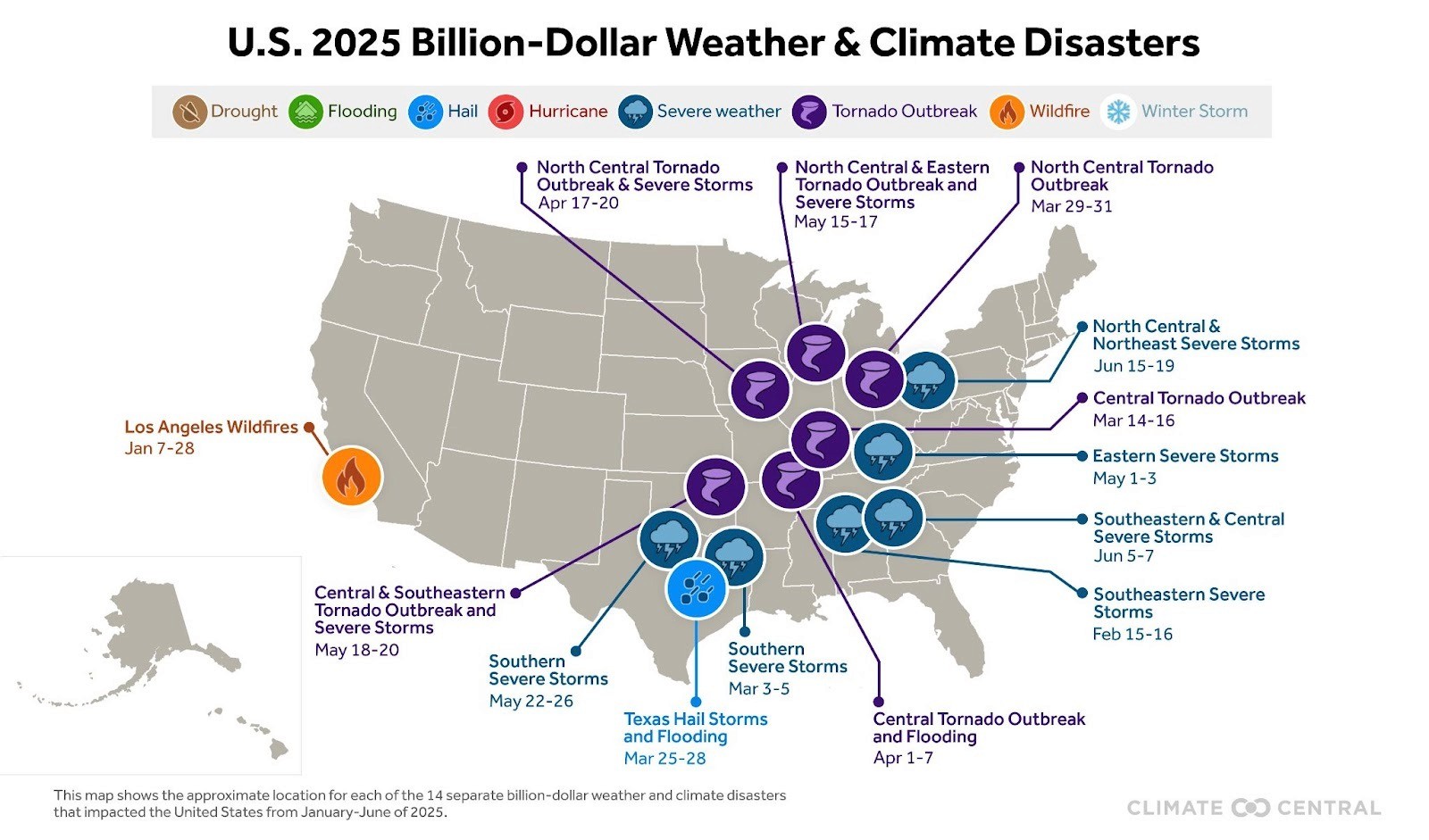
Major disasters, January-June 2025
Unfortunately, there was a great deal of uncertainty in the industry and for survivors themselves as political pressure on FEMA and other federal agencies to cut costs led to inconsistent declarations of disasters, ultimately stalling funds and slowing the pace of rebuilding. As we head into 2026, we sincerely hope there will be increased clarity for the future of FEMA and other agencies responsible for forecasting, reporting, and managing recovery efforts. It’s clear to us how vital and important recovery work is in keeping people safe, providing clarity when misinformation is rampant, and prioritizing survivors’ mental health and well being throughout the process.
How Bright Harbor’s own people saw 2025
We asked our team for their thoughts on the past year of work, and more specifically, what their biggest lesson learned was while working in recovery. Here are their insights:
On the ubiquity of underinsurance
“Even folks who purchased homes in the last 5 years can be underinsured, since most don't re-appraise or refresh their insurance annually upon renewal. Given material costs have increased 38% in the last 5 years, if a disaster hit my house, which I bought just three and a half years ago, I'd likely have at least a 20% funding gap to rebuild.”
— Caroline Williamson, Lead Product Manager
On the role of agencies working efficiently
“2025 taught me that FEMA and the SBA are critical components to recovery for the majority of people that are underinsured. Without these benefits and loans, most people would not be able to rebuild or recover solely on insurance proceeds.”
— Justin Hoellerich, Disaster Recovery Advisor
“This year taught me how difficult it can be to get aid even when you qualify. Many forms of support are interdependent on what aid you've received so far. This was counterintuitive to me; more potential grants seemed excellent, but there is a lot of added work when it comes to communicating across government, private insurance, and aid organizations. And the responsibility is all on the applicants!”
— Aaron Votre, Lead Software Engineer
On the difficulty of cleanup efforts
“The past year taught me how difficult the smoke remediation process is. Our clients have to fight so hard to get the remediation they need. Sometimes even paying for tests out of pocket and discovering there are more or worse contaminants than what the insurance tests reported, and still having to go back and forth with insurance companies after.”
— Simon Casas, Disaster Recovery Advisor
On the importance of mental health in recovery
“This year, and in particular, the Los Angeles community, has really shown me that disaster recovery challenges transcend income and circumstance. Even those with relative financial stability struggle with the complexity, the stress, and the endless administrative barriers. I’ve been reminded how powerful it is to simply stand beside people, to cheer them on when denials hit hard and the paperwork feels impossible, to help them prioritize their mental health and take recovery one step at a time. Oftentimes reminding people that they can keep going is just as critical as helping them navigate the system.”
— Heather Robson-Jones, Disaster Recovery Advisor
Wrapping up and looking ahead
“Emergency management in 2025 was not just about managing hazards in the environment. It was also about navigating hazards in governance, and the intersection of those two is where our next era will be defined.”
Pete Gaynor, former head of FEMA and president at Bright Harbor, is someone with decades of experience in recovery. His 2025 wrap-up post shares insights not only around natural disasters we survived but also the uncertainty of challenges that lay ahead.
As we look towards 2026, we hope all the survivors we’ve worked on behalf of, the organizations that sprang forth to help them, and the agencies working behind the scenes to help return everyone’s lives back to normalcy get a chance to pause, rest, and appreciate their efforts, and we hope next year goes more smoothly.