This Week in Disasters

Fires in Minnesota. Source: U.S. Forest Service-Superior National Forest
Plus, one year after Camp Mystic, Texas Hill Country is flooding again
Welcome back to This Week in Disasters! This newsletter combines expert perspectives with a weekly roundup of upcoming threats, recent natural disasters, and available survivor assistance. If you’re a Risk, Insurance, Employee Assistance, NGO or Emergency Management professional (or you’re just really curious about disasters in the United States!) you’re in the right place.
Major Disasters of the Last Week
Relentless rain sent the Guadalupe River to deadly levels across the Texas Hill Country, striking the same region that catastrophic flooding devastated in July 2025. Gov. Greg Abbott said more than 200 people had been rescued and at least two had died. Flash flood emergencies continue across the region. Read more. |
Fires ignited by a July 6 lightning storm have burned roughly 55,000 acres across northeastern Minnesota, and the U.S. Forest Service does not expect the Boundary Waters Canoe Area Wilderness to reopen this season. Milder weather on July 16 let crews resume full suppression, but the fires have pushed the worst wildfire smoke in state history as far south as the Twin Cities, and Gov. Tim Walz's statewide peacetime emergency remains in effect. Read more. |
Colorado's Aspen Acres fire nears 100,000 acres. The human-caused Aspen Acres fire in Pueblo and Custer counties is at 48% containment with mandatory evacuations still in effect. It has destroyed hundreds homes across Pueblo and Custer counties. Read more. |
Forecasted Risks for Next Week
The flash-flood threat shifts west to West Texas and the Big Bend on Friday as the system that flooded the Hill Country weakens, though the ground across the region is saturated enough that even lighter rain could set off fast flooding.
The National Hurricane Center is watching the northeastern Gulf for possible development around July 19–21, which could bring heavy rain to the Florida Panhandle and Southeast if a system organizes. Odds remain low at the moment.
The Southwest monsoon threatens flash flooding across southern Arizona, southern New Mexico, and southern Utah through the weekend. The greatest risk is near the Arizona and New Mexico borders, where atmospheric moisture is forecast above the 97.5th percentile.
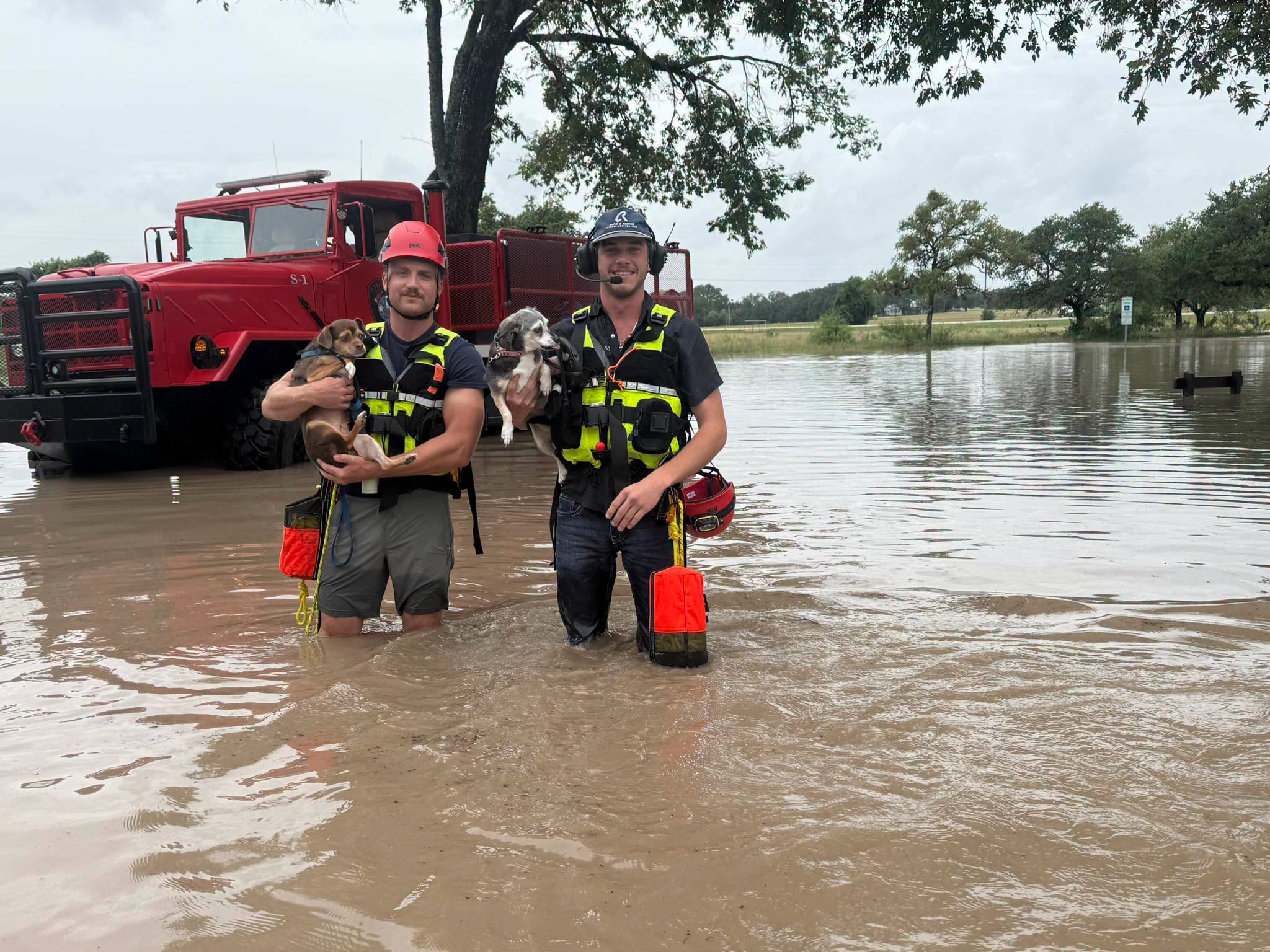
Rescues from the Texas flooding. Source: Stonewall Volunteer Fire Department
Disasters in the Headlines
The 21st Century ROAD to Housing Act Becomes Law, Reauthorizing Federal Disaster Recovery Grants
Wildfire Smoke Pushes Air Quality to Dangerous Levels for Millions
Flood-warning system gets real-world test in Hill Country rescue effort
PRO PERSPECTIVE
Two Missouri Tornadoes, Two Federal Systems

In 2011, a tornado leveled Joplin, Missouri, and the recovery moved fast, powered by active FEMA leadership and active Congressional appropriations. In 2025, a tornado tore through St. Louis, causing $1.6 billion in damage, and heavily damaging more than 2,000 homes. The system that rebuilt Joplin is not the system rebuilding St. Louis.
Sarah Labowitz has been tracking the difference. A senior fellow at the Carnegie Endowment for International Peace, she maintains the Disaster Dollar Database which tracks where federal recovery money actually goes. Her path into the field was not academic. She moved to Houston in June 2017, Hurricane Harvey hit thatAugust, and she showed up at the convention center shelter and asked where she could help. She never really left. "Disasters change your life," she says. "That's how I got into this field."
When she looks at Joplin and St. Louis, the difference she sees is structural, not meteorological.
Joplin recovered fast because the system worked. "We had strong leadership at FEMA. We had a Congress that was passing more legislation and more appropriation," Labowitz says. FEMA was run by Craig Fugate, an experienced administrator with state-level operating experience in Florida. Money moved. The recovery was, in her words, "much more coherent and quick."
St. Louis hit a different system. Labowitz describes the 2025 environment at FEMA as "chaotic austerity," a term she develops in her latest paper. The stated policy was to spend less at FEMA and, at points, to eliminate the agency. Three temporary administrators cycled through in a single year. Congress pulled back from emergency appropriations.
The local consequence was concrete. The St. Louis tornado struck on May 16. The disaster declaration did not come until June 9, more than three weeks later. "Any of that debris cleanup, police and fire overtime, that was all handled locally without any awareness of whether FEMA was going to come in," Labowitz says.
The slower, more consequential gap is in long-term recovery money, and here Labowitz is specific about a program most people have never heard of: CDBG-DR, the Community Development Block Grant Disaster Recovery program at HUD. Unlike FEMA's Disaster Relief Fund, CDBG-DR has no standing appropriation. Congress must pass a new supplemental bill to direct recovery money to a specific disaster, and HUD must then publish new rules to govern it.
That design has a cost, and the cost is time. After Harvey, Texas eventually received $10 billion in CDBG money that Labowitz calls transformational. But the timeline has stretched. Communities hit by the 2023 Hawaii wildfires waited until December 2024 for their first CDBG appropriation. Every disaster since then, St. Louis included, has received none. "They really haven't gotten any CDBG-DR money because Congress has not acted."
For anyone managing recovery, the operating assumption has changed. The federal timeline that made Joplin a success story is not the timeline St. Louis is living. Labowitz's honest brief to a St. Louis homeowner doubles as a brief to every emergency manager and recovery stakeholder reading this: "It's going to take an enormous amount of patience and persistence to be able to access those funds. And not everybody is going to be able to wait."
The equity stakes are load-bearing. Much of the damage hit North St. Louis, a historically Black, redlined community shaped by decades of redlining and disinvestment "If you don't start to get recovery dollars flowing into that part of town," Labowitz warns, people will not be able to stay, and the neighborhood will change for good.
The takeaway is not despair. It is preparation. Build local capacity to carry debris removal, overtime, and bridge financing without waiting for a federal declaration. Treat resident retention as a clock that starts the day the storm clears. And know the programs cold, because patience only pays off for the people who understand what they are waiting for.
Active Federal Declared Disasters and Deadlines
There is usually a 60 day window to apply for help after a disaster is declared. The following disasters are actively taking applications from survivors for financial support. To apply, survivors can visit DisasterAssistance.gov or call the FEMA Helpline at 1-800‑621‑3362.
Crow Tribe of Montana - Severe Winter Storm and Straight-Line WindsSTATUS Major Disaster declared May 29, 2026; IA applications accepted in eligible counties until August 1, 2026 AFFECTED COUNTIES Crow Indian Reservation |
San Carolos Apache Tribe - Severe Storms and FloodingSTATUS Major Disaster declared May 29, 2026; IA applications accepted in eligible counties until August 1, 2026 AFFECTED COUNTIES San Carlos Indian Reservation |
Mississippi - Severe Storms, Straight-line Winds, Tornadoes, and FloodingSTATUS Major Disaster declared June 30, 2026; IA applications accepted in eligible counties until August 31, 2026 AFFECTED COUNTIES Franklin, Lawrence, Lincoln, Wilkinson |
Wisconsin - Severe Storms, Tornadoes, and FloodingSTATUS Major Disaster declared June 30, 2026; IA applications accepted in eligible counties until August 31, 2026 AFFECTED COUNTIES Bayfield, Brown, Buffalo, Jackson, Jefferson, Juneau, Kenosha, Manitowoc, Marathon, Milwaukee, Outagamie, Oneida Nation, Racine, Rock, Sauk, Vernon, Washington, Waukesha, Waupaca, Winnebago |
Michigan - Severe Storms, Tornadoes, and FloodingSTATUS Major Disaster declared June 30, 2026; IA applications accepted in eligible counties until August 31, 2026 AFFECTED COUNTIES Alcona, Allegan, Alpena, Antrim, Barry, Benzie, Charlevoix, Cheboygan, Crawford, Emmet, Grand Traverse, Gratiot, Iosco, Kalamazoo, Kalkaska, Manistee, Mecosta, Montcalm, Muskegon, Newaygo, Oceana, Osceola, Presque Isle, Roscommon, Saginaw, Washtenaw, Wexford |
Louisiana - Tropical Storm ArthurSTATUS Major Disaster declared June 30, 2026; IA applications accepted in eligible counties until August 31, 2026 AFFECTED COUNTIES Avoyelles, St. Landry, St. Tammany, Terrebonne |
North Carolina - Flooding and Storm Damage from Tropical Storm ChantalSTATUS SBA disaster declaration approved July 26, 2025; applications open for residents and businesses in eight NC counties. The deadline to return economic injury applications has been extended to September 30, 2026. APPLY NOW AFFECTED COUNTIES Alamance, Caswell, Chatham, Durham, Granville, Orange, Person, Wake Counties |
Sign up for This Week in Disasters here.


