Are you a disaster survivor looking for help? Click here
This Week in Disasters

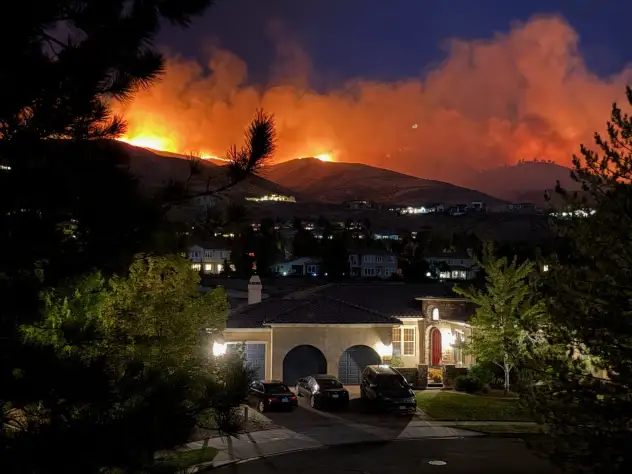
Cottonwood Fire. Source: Utah Fire Info
Plus: two moments of resilience, one week, one unanswered question: who coordinates disaster recovery now?
Welcome back to This Week in Disasters! This newsletter combines expert perspectives with a weekly roundup of upcoming threats, recent natural disasters, and available survivor assistance. If you’re a Risk, Insurance, Employee Assistance, NGO or Emergency Management professional (or you’re just really curious about disasters in the United States!) you’re in the right place.
Major Disasters of the Last Week
A tornado outbreak tore across Illinois and Indiana on Sunday, June 21, with supercells producing nearly three dozen tornado reports logged by the Storm Prediction Center. The storms damaged at least 20 homes in rural Jefferson County, Illinois, knocked out power to tens of thousands, and left two people dead there and one in Kansas. The outbreak pushed Illinois past its annual tornado record of 142, set in 2024. Read more. |
The Cottonwood Fire in Beaver County, Utah surpassed 70,000 acres at 0% containment, growing more than 10,000 acres in a day to become what the state forester called likely the most destructive and costly fire in Utah's history. The human-caused blaze, one of 353 wildfires burning across drought-stricken Utah, prompted mandatory evacuations of homes and campgrounds and a statewide fireworks ban through the Fourth of July. Read more. |
A derecho swept across Oklahoma overnight into Monday, June 22, driving widespread wind damage from the northwest of the state through the Oklahoma City metro. In El Reno, high winds damaged eight to 10 homes and downed power lines and trees, and in Woodward County a BNSF train was derailed near U.S. Highway 412. Outages peaked above 83,000 statewide, with more than 36,000 customers still without power as damage assessments continued. Read more. |
The Iron Fire near Eureka, in Juab County, Utah, grew to 37,172 acres at 23% containment since igniting June 19, with crews halting its eastward run through Pinyon Canyon using a firing operation. Thousands of evacuated residents of Eureka and Chimney Rock Pass were cleared to return Thursday under a reduced "set" status, ready to leave again at a moment's notice. Read more. |
Forecasted Risks for Next Week
The National Weather Service has issued Utah's first-ever Particularly Dangerous Situation red flag warning as extremely critical fire weather hits the Southwest Friday into Saturday. The warning covers Beaver, Iron, Piute, Garfield, and Washington counties and the active Cottonwood Fire, with southwest winds gusting to 50 mph and humidity as low as 5 percent; the Storm Prediction Center places central and southwestern Utah, northwest Arizona, and southeast Nevada in its highest, Level 3 of 3, extremely critical category.
Severe thunderstorm complexes are expected to ride the northern rim of that heat dome, from the Dakotas to the Upper Midwest and Great Lakes, late this weekend into early next week. Damaging straight-line winds and flooding downpours are the primary threats, and the pattern favors fast-moving, long-lived storm clusters capable of becoming derechos.
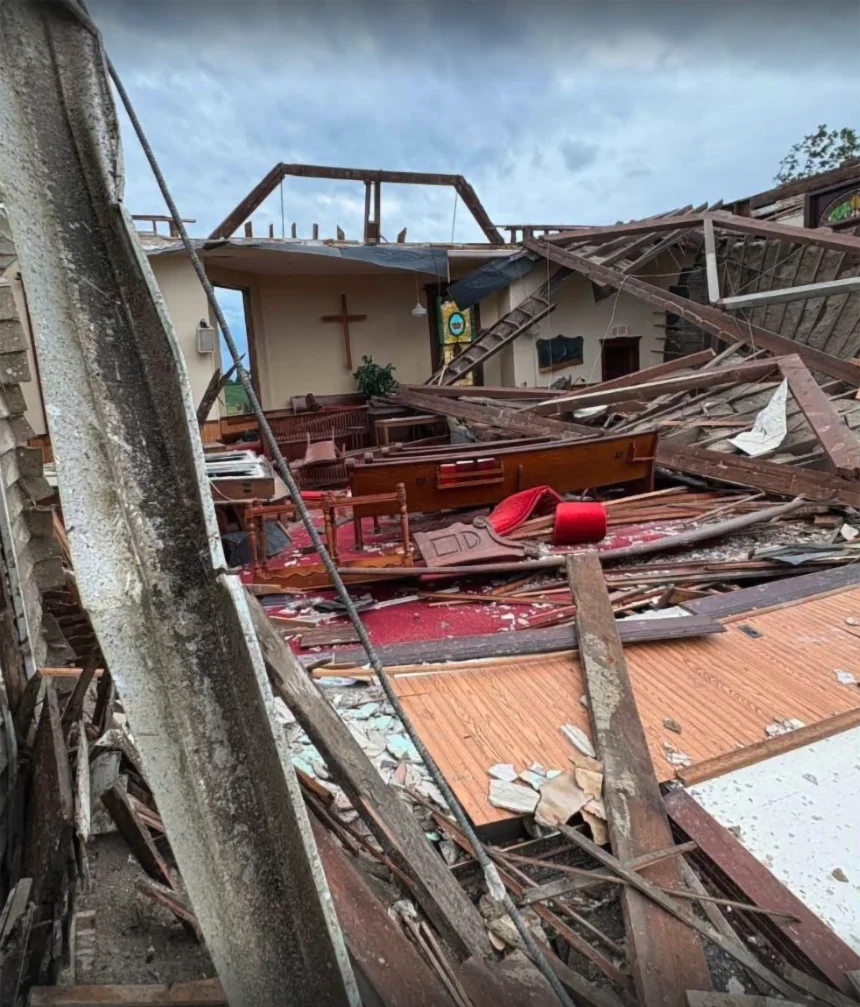
A 96-year-old chapel destroyed in severe storms in Gibson County. Source: Gibson County Sheriff's Office.
Disasters in the Headlines
White House Unveils President Trump’s America First Resilience Strategy
The San Andreas fault just reached a level scientists haven’t seen in 1,000 years—Is California ready for what comes next?
Strong El Niño Potential Raises Concerns of Long-Term Drought & Mini-Dust Bowl Scenario
Modernization Handbook: Advancing NIMS and ICS for the Era of Autonomous Systems and Complex Disasters
Congress expands disaster aid, as Trump seeks to limit it
FEMA official who claimed he teleported to Waffle House steps down from post
PRO PERSPECTIVE
The Willingness to Help Has Never Been the Problem. Coordination Is.

I spent this past week at the Disaster Resilience Summit, the same week the White House released the National Resilience Strategy. Credit to the U.S. Chamber of Commerce Foundation for convening it, and for pulling together a genuinely senior cross section of decision-makers and operators across government, private industry, and VOADs around a practical question: when disaster hits, how do these sectors work together, and who is responsible for the work that falls between them. The strategy takes up the same subject from Washington, in the form of a national directive. Its answer is built on federalism: it distributes responsibility across states, industry, and individuals, and focuses the federal government on events that exceed state and local means.Same week, same subject, and the contrast was clarifying.
The summit's central unanswered question was never whether people want to help. They do, across private industry, the government and the VOAD ecosystem, with a commitment that is genuinely one of this country's strengths. The hard question was who leads, and how we orchestrate delivery so resources actually reach survivors efficiently. The strategy answers the "who" with conviction. It is mostly silent on the "how." That gap is the whole story.
Start with where they agree, because it matters. Both the summit and the document name the same broken default: the federal government stuck as the primary risk owner and liability holder, even for routine incidents. From my time in the federal government, I can tell you that posture reached the limit of its utility a long time ago. Naming it plainly is a real contribution, and the strategy deserves credit for it.
The problem is what comes next. The "Distribute" tenet reassigns ownership to states, individuals, and industry through federalism. But redistributing responsibility is not the same as solving coordination. We are not short on diagnosis here. There is a shelf full of after-action reports from every major disaster of the last two decades, and they keep pointing at the same thing: the connective tissue between actors.. The gap has never been diagnosis. It's action. What we have never managed to do is act on what those reports already tell us. Push the load outward without building an orchestration layer and you don't fix that failure; you scatter it across actors less equipped to coordinate with each other than Washington was. The "Simplify" tenet gets framed as cutting redundant advisory bodies and clarifying roles. Useful. But simplifying governance is not the same as coordinating delivery, and the document treats them as one thing.
Then there's the question of whether the field is ready to carry the everyday load the strategy hands it. States are told to fund emergency management as a core function, lean less on federal grants, and strengthen insurance markets that price risk and reward hardening. Directionally, that's sound. But it assumes a level of capacity that does not exist uniformly. I've spoken with state EM teams who confirmed what the data already suggests: some states fund emergency management because federal grants backfill it. Several depend on that funding to operate at all, let alone respond and recover. Remove the backfill and you expose wide variance in state maturity, and the load lands hardest on the least-resourced jurisdictions. That argues for a phased transition, not a cliff: pair the pullback with a deliberate runway that lets states build fiscal and operational capacity before the support recedes, rather than assuming the capacity is already there.
The insurance piece deserves the same scrutiny. I spent years in insurance, and the strategy's logic is coherent: price risk accurately, reward hardening, and as risk falls, affordability follows. The theory holds. The problem is timing. Hardening a housing stock and re-pricing a market is a multi-year arc; the unaffordability is immediate. Accurate pricing lands today as a bill many households can't carry, well before the resilience that's supposed to lower it takes hold. The same phased-transition logic the states need applies here, and the strategy doesn't address how families bridge that gap.
My takeaway is this. The field is overflowing with willingness, and that was the summit’s clearest signal. The failure has always been converting that energy into coordinated progress. A more distributed model makes that harder, not easier, unless someone builds the orchestration layer between states, carriers, VOADs, and survivors. With the federal government deliberately pulling back, public-private partnership stops being a nice-to-have and becomes the load-bearing wall. And whatever we build, the test should stay simple: does it get a displaced family to stability faster? Debt reduction and freedom of action are meaningful goals, but they may miss the point if survivors aren't actually supported.
Active Federal Declared Disasters and Deadlines
There is usually a 60 day window to apply for help after a disaster is declared. The following disasters are actively taking applications from survivors for financial support. To apply, survivors can visit DisasterAssistance.gov or call the FEMA Helpline at 1-800‑621‑3362.
Crow Tribe of Montana - Severe Winter Storm and Straight-Line WindsSTATUS Major Disaster declared May 29, 2026; IA applications accepted in eligible counties until August 1, 2026 AFFECTED COUNTIES Crow Indian Reservation |
San Carolos Apache Tribe - Severe Storms and FloodingMajor Disaster declared May 29, 2026; IA applications accepted in eligible counties until August 1, 2026 AFFECTED COUNTIES San Carlos Indian Reservation |
North Carolina - Flooding and Storm Damage from Tropical Storm ChantalSTATUS SBA disaster declaration approved July 26, 2025; applications open for residents and businesses in eight NC counties. The deadline to return economic injury applications has been extended to September 30, 2026. APPLY NOW AFFECTED COUNTIES Alamance, Caswell, Chatham, Durham, Granville, Orange, Person, Wake Counties |
Sign up for This Week in Disasters here.