Are you a disaster survivor looking for help? Click here
This Week in Disasters

Aspen Acres Fire. Source: Pueblo County Sheriff's Office
Also inside: a super typhoon may strike Guam this weekend and the case for sending disaster aid where the data points, not where the politics do.
Welcome back to This Week in Disasters! This newsletter combines expert perspectives with a weekly roundup of upcoming threats, recent natural disasters, and available survivor assistance. If you’re a Risk, Insurance, Employee Assistance, NGO or Emergency Management professional (or you’re just really curious about disasters in the United States!) you’re in the right place.
Major Disasters of the Last Week
Over 3 million acres have burned nationally so far in 2026, which is ahead of the 10-year average. National wildfire preparedness was raised to Level 4 of 5. Read more.
The Aspen Acres Fire in southern Colorado's Pueblo and Custer counties burned to more than 50,000 acres with zero containment, damaging or destroying roughly 180 structures. The fire has prompted repeated new mandatory evacuation orders as high winds pushed it east. Read more. |
The Snyder Fire near the Colorado-Utah border grew to more than 30,000 acres and reached 65 percent containment by burning largely in Mesa County after several lightning-sparked fires merged in high winds. Read more. |
The Gold Mountain Fire north of Ouray, Colorado grew to over 18,000 acres with no containment, forcing evacuations across several communities. A cell tower destroyed by the fire has left many residents unable to receive evacuation messaging. Read more. |
Up to eight inches of rain triggered flash flooding across central and southern Kentucky over the weekend of June 27 and 28, closing roads statewide and prompting more than 63 water rescues as 18 local governments declared states of emergency. Governor Andy Beshear said he plans to request federal assistance Read more. |
Forecasted Risks for Next Week
Critical fire weather will persist across Utah, Colorado, northern Arizona, and New Mexico. Single-digit humidity and gusty winds over drought-stricken areas keep the danger high.
Tropical Storm Bavi is forecast to strengthen into a super typhoon and pass through the Marianas around July 5 and 6, threatening the U.S. territories of Guam and the Northern Mariana Islands. Forecasters say it could become the strongest July typhoon on record to pass through the region.
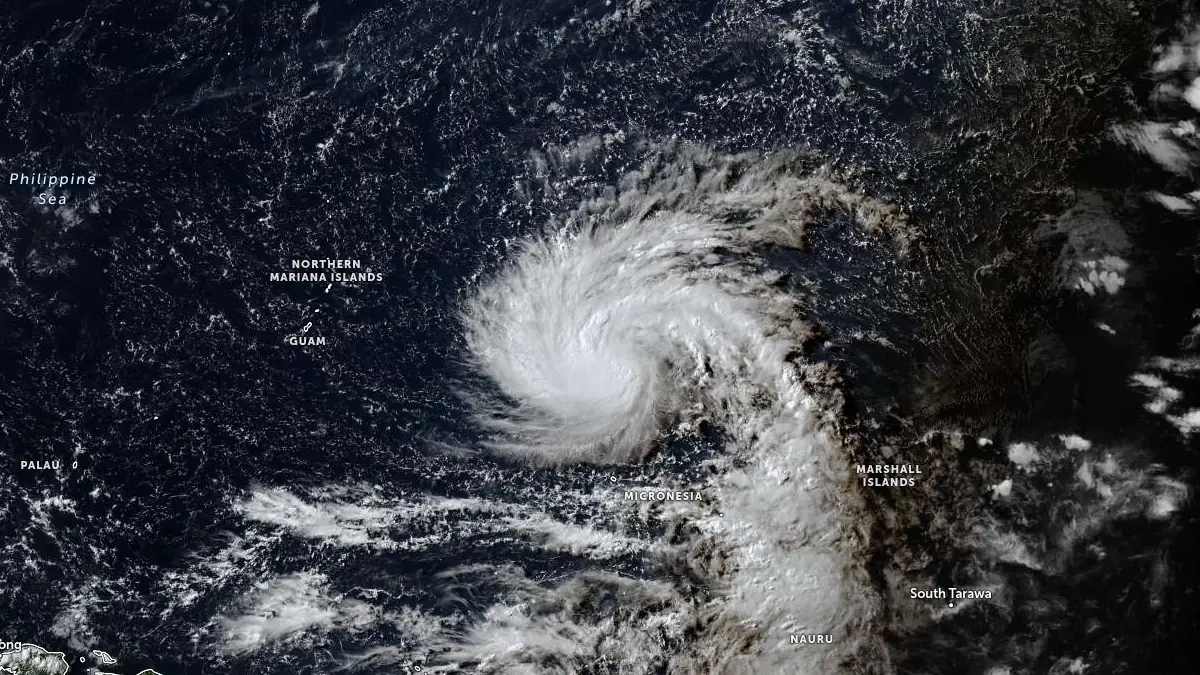
Tropical Storm Bavi. Source: Zoom Earth
Disasters in the Headlines
This July 4th could be hottest ever in parts of U.S. Maps show the forecast expected to break records.
They were the ‘unsung heroes’ of firefighting. Their deaths mark a grim milestone for the new wildland fire service
Bipartisan bill would allocate CDBG funds to disaster prevention efforts
PRO PERSPECTIVE
Sending Resources Where the Evidence Points

Give Curtis Brown a fixed pot of money and a map of competing needs, and he will not split it evenly. He will ask what the data says and send the money where it does the most good. That instinct, built across nearly every level of emergency management, runs through the way he works.
Brown moved through nearly every level of the profession: Capitol Hill, a governor's office, regional planning, and the top operational seat in Virginia, where he became the first African-American to serve as the Commonwealth's State Coordinator of Emergency Management. Today he teaches at the Wilder School at Virginia Commonwealth University and consults. He calls himself a "pracademic," and he means it as a working method, not a label: keep one foot in the field and one in the research, and refuse to let either drift from the other.
That method shows first in how he reads a disaster before it lands. Brown frames impact through "stresses and shocks." Some communities already absorb daily stresses: food deserts, thin infrastructure, limited access to health care. "In a really amazing way they are resilient," he says, "despite not getting the services and the support that they need." A disaster is the shock that hits those already-stretched resources, which is why the casualties and the economic loss tend to concentrate in predictable places. Read the stresses, and you can forecast where the shock will land hardest.
If the impact is that predictable, the dollars should follow it, not spread evenly in the name of fairness. Brown put that to work during COVID, when Virginia received a one-time infusion of federal Emergency Management Performance Grant (EMPG) funding. The state had 133 localities. "You could divvy up the money 133 different ways and everyone got a couple thousand bucks," Brown says. "Or you could prioritize it and be strategic based on need and impact." His team tracked indicators of where fatalities and needs were concentrated, directed the one-time money there, and told lower-impact localities to keep doing what they were doing while the state found other ways to support them.
The data came from many directions at once: academic institutions, private-sector partners with proprietary tools, local governments, and hospital and healthcare partners all reporting in. The method outlasts the emergency. Brown points to an internal study mapping where Virginians with disabilities were concentrated, which showed heavy clusters in the southwest and Southside. That finding reshaped state sheltering and evacuation planning. The Eastern Shore makes the same point through geography: a senior-heavy region cut off from the rest of the state by water and a bridge. His 96-year-old grandmother lived there, with no cell phone and no social media. When a plan leans on a text message or a social post, he asks the question planners skip: who does that exclude?
He is direct about where this breaks down. Research shows disaster declarations and resource allocation have been politicized, he notes, to the point where a state's political alignment can shape what it receives. He argues for consistent, data-driven thresholds instead. "The need is the need," he says, pointing out that both parties represent under-resourced urban and rural communities devastated by storms like Sandy, Michael, and Helene. He has co-authored work making the bipartisan case for an equity lens. His framing stays reform-minded rather than cynical: "This is when the government is supposed to work."
The same evidence-first habit shapes how he thinks about who does the work. As disasters grow more frequent, emergency management has to expand, and that expansion opens seats. Brown wants them filled by people who reflect the communities the field serves, recruited from the places disasters hit hardest. He frames it as widening the table as the work grows, not as closing a deficit. Bringing those people in does two jobs at once: it staffs a growing field, and it strengthens its reach into the communities that need it most.
His confidence rests on the next generation. He points to students who take their own mental health and the trauma of disaster survivors seriously, a focus he says his generation underweighted at real cost. He is not sentimental about them. He treats them as a workforce the field cannot afford to lose, and he is pushing colleagues to bring them in now. The throughline holds from grant formulas to staffing decisions: know who the system tends to miss, then build deliberately toward them.
Active Federal Declared Disasters and Deadlines
There is usually a 60 day window to apply for help after a disaster is declared. The following disasters are actively taking applications from survivors for financial support. To apply, survivors can visit DisasterAssistance.gov or call the FEMA Helpline at 1-800‑621‑3362.
Crow Tribe of Montana - Severe Winter Storm and Straight-Line WindsSTATUS Major Disaster declared May 29, 2026; IA applications accepted in eligible counties until August 1, 2026 AFFECTED COUNTIES Crow Indian Reservation |
San Carolos Apache Tribe - Severe Storms and FloodingSTATUS Major Disaster declared May 29, 2026; IA applications accepted in eligible counties until August 1, 2026 AFFECTED COUNTIES San Carlos Indian Reservation |
[NEW] Guam - Super Typhoon SinlakuSTATUS Major Disaster declared June 30, 2026; IA applications accepted in eligible counties until August 31, 2026 AFFECTED COUNTIES Territory of Guam |
[NEW] Mississippi - Severe Storms, Straight-line Winds, Tornadoes, and FloodingSTATUS Major Disaster declared June 30, 2026; IA applications accepted in eligible counties until August 31, 2026 AFFECTED COUNTIES Franklin, Lawrence, Lincoln, Wilkinson |
[NEW] Wisconsin - Severe Storms, Tornadoes, and FloodingSTATUS Major Disaster declared June 30, 2026; IA applications accepted in eligible counties until August 31, 2026 AFFECTED COUNTIES Bayfield, Brown, Buffalo, Jackson, Jefferson, Juneau, Kenosha, Manitowoc, Marathon, Milwaukee, Outagamie, Oneida Nation, Racine, Rock, Sauk, Vernon, Washington, Waukesha, Waupaca, Winnebago |
[NEW] Michigan - Severe Storms, Tornadoes, and FloodingSTATUS Major Disaster declared June 30, 2026; IA applications accepted in eligible counties until August 31, 2026 AFFECTED COUNTIES Alcona, Allegan, Alpena, Antrim, Barry, Benzie, Charlevoix, Cheboygan, Crawford, Emmet, Grand Traverse, Gratiot, Iosco, Kalamazoo, Kalkaska, Manistee, Mecosta, Montcalm, Muskegon, Newaygo, Oceana, Osceola, Presque Isle, Roscommon, Saginaw, Washtenaw, Wexford |
[NEW] Louisiana - Tropical Storm ArthurSTATUS Major Disaster declared June 30, 2026; IA applications accepted in eligible counties until August 31, 2026 AFFECTED COUNTIES Avoyelles, St. Landry, St. Tammany, Terrebonne |
North Carolina - Flooding and Storm Damage from Tropical Storm ChantalSTATUS SBA disaster declaration approved July 26, 2025; applications open for residents and businesses in eight NC counties. The deadline to return economic injury applications has been extended to September 30, 2026. APPLY NOW AFFECTED COUNTIES Alamance, Caswell, Chatham, Durham, Granville, Orange, Person, Wake Counties |
Sign up for This Week in Disasters here.