Are you a disaster survivor looking for help? Click here
This Week in Disasters

Remnants of Hurricane Isaias. Source: Florida Department of Transportation
Plus, Hurricane Isaias cut power to more than 840,000 customers across three states
Welcome back to This Week in Disasters! This newsletter combines expert perspectives with a weekly roundup of upcoming threats, recent natural disasters, and available survivor assistance. If you're a Risk, Insurance, Employee Assistance, or Emergency Management professional (or you're just really curious about weather in the United States!), you're in the right place.
If you want to receive exclusive news, updates, and job postings, sign up for This Week in Disasters here.
Major Disasters of the Last Week
Hurricane Isaias made landfall near Destin, Florida the evening of October 9 as a Category 2 storm with wind gusts reaching 118 mph. The Atlantic's first hurricane of 2026 knocked out power to more than 400,000 Florida customers at its peak. Karen Clark & Company estimates privately insured losses of the hurricane at $3 billion. Read more. |
The remnants of Tropical Storm Rachel dropped 1.08 inches of rain on Las Vegas into Sunday morning, October 11, tying the city's all-time daily rainfall record for October. Floodwaters ran through streets near the Strip, where crews pulled drivers from standing water. The same system battered the Southern California coast with unusually large waves that tore apart a boardwalk and damaged beachfront homes in Long Beach. Read more. |
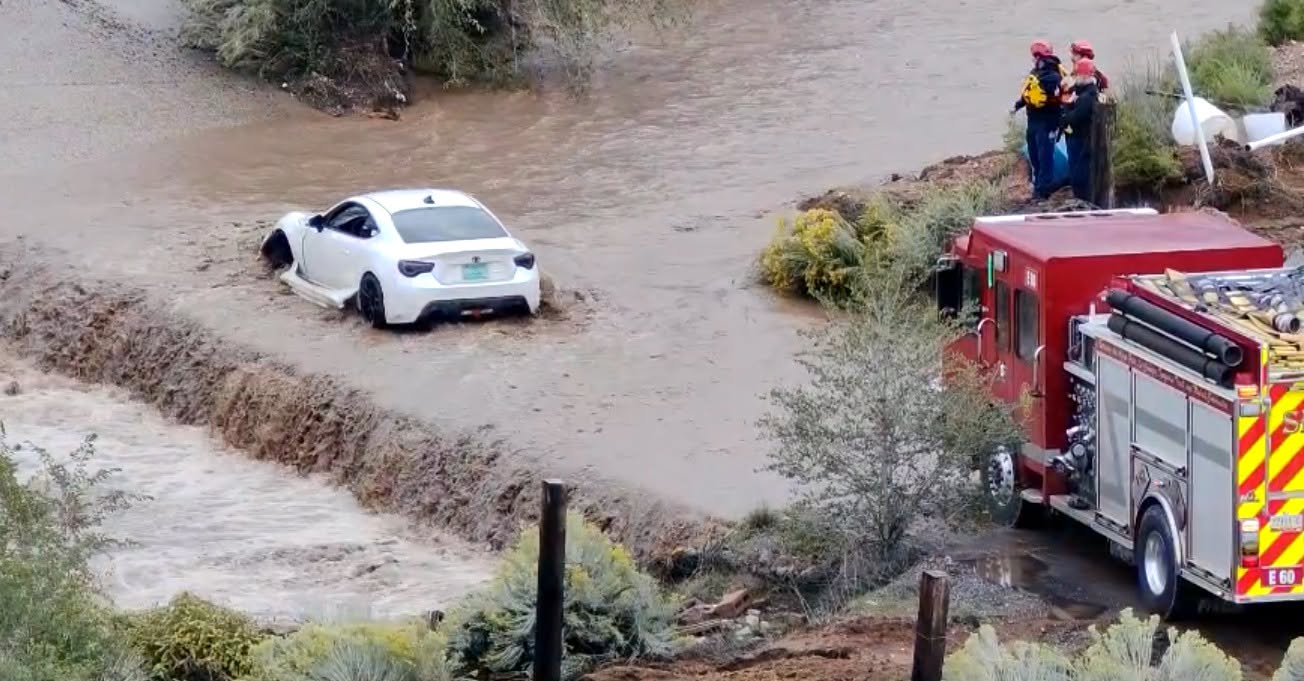
Slow-moving thunderstorms dropped 3 to 6 inches of rain on the Oklahoma City metro on October 14. Flash flooding washed out part of a road and surrounded a home with floodwater in Blaine County, where crews made at least one high-water rescue near Greenfield. Flooding closed two highways in Kingfisher County and swamped neighborhoods in northwest Oklahoma City. Read more. |
Forecasted Risks to Watch for the Next Week
The Canadian River will crest across central Oklahoma through Saturday after this week's rain. Major flooding is already occurring near Bridgeport, and NWS Norman forecasts the river at Norman to crest at 98.7 feet early Saturday. Flood warnings from Blaine County to Norman run into late Sunday night.
The season's first widespread frost and freeze threaten the Mid-Atlantic and Northeast on Sunday and Monday. The Weather Prediction Center flags frost and freeze conditions across parts of both regions behind a departing cold front.

Source: Long Beach City
Disasters in the Headlines
"How California Is Using A.I. and Cameras to Stop Wildfires"
"Disasters cost $228 billion in housing losses every year"
PRO PERSPECTIVE
Memory Is the Infrastructure No One Maintains

In 1907, a tsunami killed a large share of the population of Simeulue, an Indonesian island off Sumatra. Survivors folded what they learned into songs, festivals, and lullabies. In English, the most common version of the lullaby tells listeners that when a strong earthquake hits and the ocean draws back, they should hurry to higher ground. On December 26, 2004, Simeulue sat about 60 kilometers from the epicenter of the Indian Ocean earthquake. Only seven of its roughly 78,000 residents died.
Daniel Starosta Rubio, Founder and Research Lead of Brackish Projects, treats that outcome as the payoff of a choice the island made a century earlier. A humanitarian aid worker and social vulnerability researcher, he has worked on glacial lake flood planning in Bhutan and on recovery in Maui. His UC Berkeley thesis spanned case studies from 29 countries across 40,000 years, and according to the university, he is the only graduate student on record to submit a Spotify playlist as part of one. He is now writing a book on disaster culture, memory, and identity. His case to emergency managers is that a community's memory of disaster is infrastructure, and it decays on a schedule unless someone maintains it.
Memory Runs on a 75-Year Clock
Starosta cites research giving a community about 2.5 generations, roughly 75 years, before it starts losing the lessons of a calamity. Japan's tsunami stones show the decay. Some stones, carved as early as the 14th century, warned villages not to build below a set line and held that authority for centuries. Others washed away or stood ignored while families moved downhill toward the river and the fishing.
"If your grandparents talk about war stories that you don't know, viscerally, yourself, you're prone to disregarding them in the same way," Starosta says. "We want what we think is ease, and are quick to dismiss risks we don't recognize."
Simeulue beat that clock by investing in its own memory, and no agency told it how.
Adoption Can Smother the Story
"When a corporation tries to use a meme or cultural moment in an ad, it almost instantly makes it uncool," Starosta says. Official preparedness programs run the same risk when they adopt folk knowledge.
Japan shows how much has to line up to beat it. After the 1855 Ansei Edo earthquake, residents who could not safely criticize the government's response aimed their anger at a catfish instead. Hundreds of woodblock prints cast Namazu, the giant catfish said to live under Japan and cause its tremors, as a stand-in for the officials they could not name. Today a catfish appears on official earthquake signage. The symbol stuck because Japan had a long quake history, a shared visual language, and a modern warning system ready to carry it.
Everywhere else, Starosta says, the work has to run top-down and bottom-up at once. From the top, the official program has to treat culture as infrastructure worth championing. He points to a century of American bans on cultural burning, the Indigenous practice of setting small, controlled fires to clear fuel and renew land. Agencies are only now reconsidering them. From the bottom, there has to be a kernel of a story that already engages with risk, held by a community willing to meet formal systems halfway.
Start at Someone's Table
The first step for finding that kernel is low-tech. "It's an admittedly annoying answer, but talk to people. Eat at their table. Hear their story," he says.
Conversation matters because people rarely recognize their own cultural knowledge, so they won't name it when asked directly. Growing up with Florida hurricanes, Starosta knew which neighbors lost power, who had generators or grills, and whose shutters would hold. None of it felt like culture to him. That kind of knowledge comes out in stories told over a meal, and it doesn't have to be highbrow to count: FEMA reads Waffle House closures as a hurricane severity signal.
Once you're at the table, ask about more than the house. Start with what residents value: which place or event matters most here, and how do we preserve it? Then map the social fabric: who is new to town, who has been there six generations, who needs support, and who offers it. Those answers tell a planner what a community is trying to protect and who will carry it. In Bhutan, Starosta helped planners build lists of questions like these, so they stopped reading communities only through their physical hazard profile.
Preparedness Is a Luxury
Listening also surfaces a fact programs avoid: preparedness is a luxury. In Florida, a Boynton Beach marina repainted "Not here, Wilma! Go around!" on its roll-gate with each new storm's name for a decade. The humor keeps hurricanes in daily life and keeps them from feeling serious.
Starosta lays out a ladder: recognition of risk, then passive engagement, active engagement, ability to prepare, willingness to prepare, and incentive to prepare. Skip the rungs and trauma becomes the only teacher, and trauma only teaches when people have support to work through it. Cultural networks provide that support, and their absence shows in recovery. After the Maui fires, he fielded calls for almost a year from members of the island's small Mexican community, who lacked the cultural support other communities leaned on. A mutual aid group or resilience organization already in place, he argues, means fewer people fall through the cracks once the cameras and volunteers leave.
A Plaza Can Do What a Lullaby Did
Asked to design an American town's equivalent of Simeulue's lullabies, Starosta picks a place over a song: a memorial plaza or a distinctive fire tower that hosts weekend soccer, town halls, and class trips until residents use it as a landmark, the way he, raised in Florida, still dates memories by hurricanes Ivan, Frances, Charley, Wilma, and Jeanne. The goal, he says, is preparedness disguised as ordinary life. He would know it had worked when middle schoolers in a fire-prone town test which tree bark resists flame as a routine science experiment, and nobody thinks of it as disaster prep. Simeulue's lullabies worked the same way. Generations of children heard them without thinking of them as preparedness, and on December 26, 2004, when the Indian Ocean pulled back from Simeulue's shore, they ran for high ground.
Active Federal Declared Disasters and Deadlines
There is usually a 60 day window to apply for help after a disaster is declared. The following disasters are actively taking applications from survivors for financial support. To apply, survivors can visit DisasterAssistance.gov or call the FEMA Helpline at 1-800‑621‑3362.
West Virginia - Severe Storm and FloodingSTATUS Major Disaster declared October 7, 2026; IA applications accepted in eligible counties until December 7, 2026 AFFECTED COUNTIES Fayette, Harrison, Kanawha |
Wisconsin - Severe Storms and TornadoesSTATUS Major Disaster declared August 3, 2026; IA applications accepted in eligible counties until October 3, 2026 AFFECTED COUNTIES Rota (Municipality) |
Mississippi - Tropical Storm ArthurSTATUS Major Disaster declared October 7, 2026; IA applications accepted in eligible counties until December 7, 2026 AFFECTED COUNTIES Forest, Outagamie, Vilas, Winnebago |
Indiana - Severe Storm, Straight-line Winds, Tornadoes, and FloodingSTATUS Major Disaster declared August 25, 2026; IA applications accepted in eligible counties until October 25, 2026 AFFECTED COUNTIES Hancock, Harrison, Pearl River, Stone |
Guam - Super Typhoon BaviSTATUS Major Disaster declared October 7, 2026; IA applications accepted in eligible counties until December 7, 2026 |
Ohio - Severe Storm, Straight-line Winds, Tornadoes, Flooding, and LandslidesSTATUS Major Disaster declared October 2, 2026; IA applications accepted in eligible counties until December 1, 2026 AFFECTED COUNTIES Clermont, Franklin, Hamilton, Licking, Morgan, Muskingum, Perry |
Hawaii – Kona EarthquakeSTATUS AFFECTED COUNTIES Hawaii |
Oglala Sioux Tribe – Severe Storms, Straight-line Winds and FloodingSTATUS Declared September 1, 2026. Individual Assistance available across the Pine Ridge Reservation. No application deadline has been published yet; check DisasterAssistance.gov. |
Sign up for This Week in Disasters here.