This Week in Disasters
More Than 43,000 Evacuated in Simi Valley
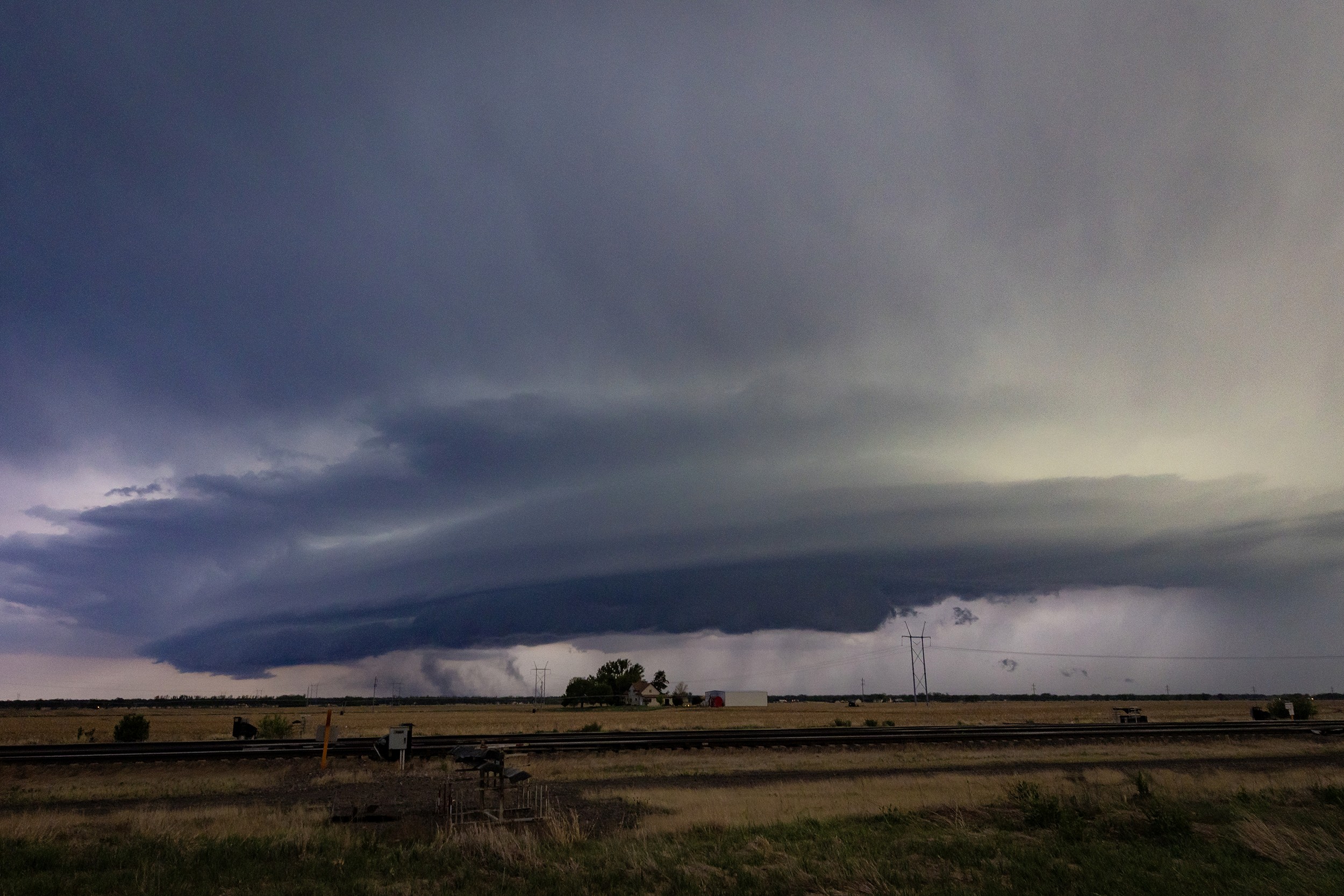
Source: Tornado in Nebraska. Source: Central Nebraska Today
Plus: Why it’s time to retire FEMA’s easy button
Welcome back to This Week in Disasters! This newsletter combines expert perspectives with a weekly roundup of upcoming threats, recent natural disasters, and available survivor assistance. If you’re a Risk, Insurance, Employee Assistance, NGO or Emergency Management professional (or you’re just really curious about disasters in the United States!) you’re in the right place.
Major Disasters of the Last Week
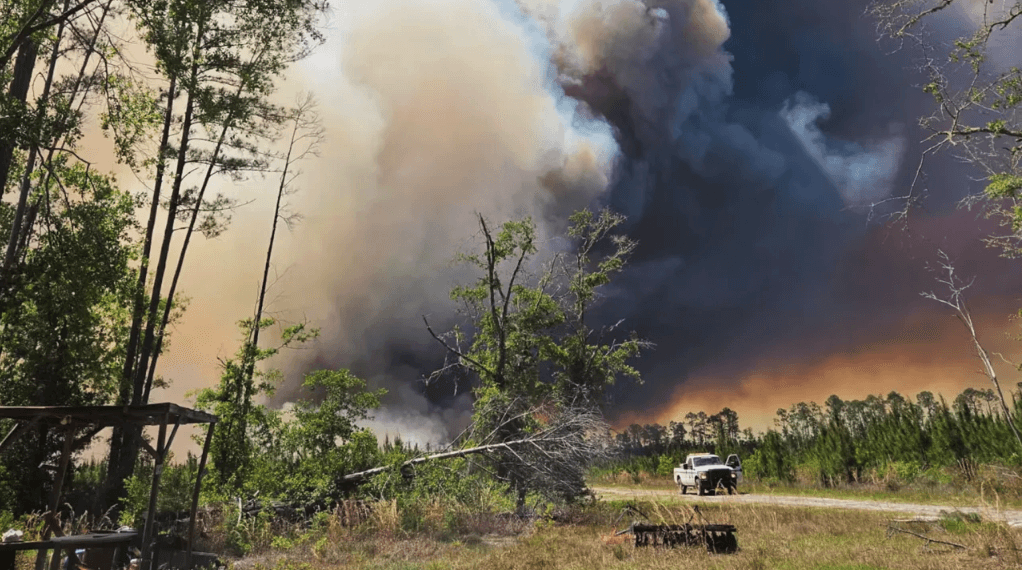
The Stinky Fire destroyed 52 homes and damaged 25 more after igniting May 17 at the Amarillo City Landfill and spreading across 2,300 acres of Potter County under 45 to 50 mph winds. Read more. |
An EF-3 tornado with 160 mph winds touched down north of St. Libory in Howard County on May 17, destroying four newly built homes on Denton Circle and damaging power infrastructure. Read more. |
A wind-driven brush fire that ignited May 18 in Ventura County has burned 2,115 acres with 22% containment as of May 21, destroyed one home, and prompted evacuation orders for more than 43,000 people. California Governor Gavin Newsom secured a FEMA Fire Management Assistance Grant; more than 750 firefighters remain assigned. Read more. |
Forecasted Risks for Next Week
Heavy rain and flash flooding from Texas through the Ozarks through the weekend. Southeast Texas has already absorbed 6 to 9 inches this week, with several more expected over saturated ground; localized totals of 7 to 10 inches are possible in the Ozarks, leading to potential flash floods.
Severe storms shift east Friday into the Ohio Valley, Mid-Atlantic, and southern New England. Damaging winds and hail are the primary threats, with a separate severe threat over southwest Texas overnight into Saturday.
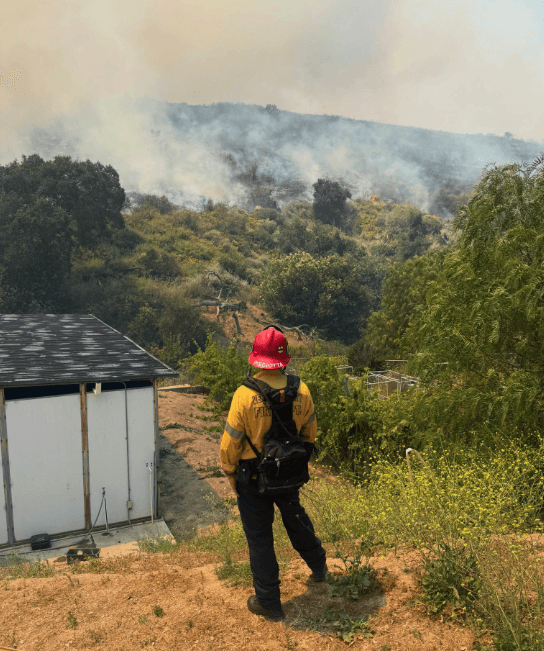
The Sandy Fire. Source: CAL FIRE
Disasters in the Headlines
Triple-I and NICB Warn Homeowners to Watch for Contractor Fraud Following Disasters
Emerging Wellness Trend: Disaster-Proof Architecture
Red Cross and U.S. Chamber of Commerce Foundation Partner to Help Small Businesses Prepare for Disasters
PRO PERSPECTIVE
FEMA Built the Easy Button. Colt Hagmaier Says It's Time to Retire It.

When disaster strikes, the expectation has long been simple: the federal government will show up. But Colt Hagmaier, who spent 13 years at FEMA rising to lead the agency's entire recovery enterprise, believes that expectation has become one of the most dangerous assumptions in American emergency management.
"FEMA became the easy button," he says. "And because it became the easy button, most states and locals rarely looked at what they had around them."
Hagmaier is not a critic from the outside. He was among the people running the machine. As a Senior Executive Service official overseeing FEMA's recovery operations, he managed a workforce of roughly 10,000 people and helped administer approximately $15 billion annually in recovery grants and programs. He also spent years as a senior attorney in the Office of Chief Counsel. Before any of that, he was a paramedic at 18, a swift water rescuer, a wilderness search and rescue volunteer, and later Harvard University's first emergency manager. After applying repeatedly for FEMA positions without landing an interview, he took his mentor's advice and went to law school, betting that a legal background would set him apart in a field where few attorneys wanted to work. It did.
That combination of practitioner grit, legal precision, and executive-level responsibility gives Hagmaier a rare vantage point on a system that is, by all accounts, in the middle of a significant shift.
The Accretion Problem
Hagmaier traces FEMA's current challenges not to any single administration, but to a structural pattern stretching back to 1950. Every major piece of legislation since then, he argues, has added responsibility to FEMA without ever taking any away.
"Every time, whether it's the Stafford Act amendments or any of the others, they all add responsibility to FEMA. Never do they take it away. It's always accretional."
The result was an agency asked to do more than its mandate envisioned, funded inconsistently, and gradually redefined as the lead agency for disasters rather than the backstop of last resort. COVID-19 made it vivid: pandemic response had long been modeled as an HHS responsibility, with FEMA playing a minimal role in exercises. When the real event arrived, the work came back to FEMA anyway. "FEMA is a place where stuff gets done," Hagmaier says.
States Are More Ready Than They Think
Hagmaier now works with governors and state directors through AECOM, helping them scenario-plan for a world where federal support looks different. He is careful not to flatten the landscape. Some states already have dedicated disaster relief funds and individual assistance programs. Others are starting from scratch. But he shares a conviction with many former federal officials: states routinely underestimate what they already have.
In a full-day tabletop exercise he facilitated in Maryland, cabinet officials who rarely engage with disaster policy began connecting existing non-disaster programs to disaster contexts for the first time, simply because the exercise forced the question.
His warning for those who don't engage proactively is direct. "If the federal government pulls back and you don't accept that risk and manage it effectively, states are going to end up paying for it one way or another. Either under existing social service programs that see a giant bump in demand, or your communities suffer, homes go unrepaired, there's blight, economic depression."
The advice for state and local leaders: lean forward now, not after the next declaration denial.
The One Thing Decision Makers Need to Understand
Asked what he would tell an incoming FEMA administrator, Hagmaier didn't reach for a policy prescription. He reached for a leadership principle.
"Success comes from the bottom. You have to empower people to do their jobs and trust them. But they have to understand the vision. Right now, because of all the ambiguity around the FEMA Council, the FEMA Act, the public statements about the agency's purpose, it has really undermined a consistent understanding of what the goal is. When you articulate that clearly, success will follow."
For a profession built on planning for uncertainty, that clarity is not a luxury. It is the prerequisite for everything else.
Hagmaier has seen this system from nearly every angle: the field, the courtroom, the executive suite, and now the advisory table. His message is not alarmist. It is a call to action. The easy button is being retired. The question is whether states, communities, and the professionals who serve them are ready to pick up what comes next.
Active Federal Major Disasters
There is usually a 60 day window to apply for help after a disaster is declared. The following disasters are still actively taking applications from survivors for financial support.
The following disasters are actively taking applications from survivors for financial support. To apply, survivors can visit DisasterAssistance.gov or call the FEMA Helpline at 1-800‑621‑3362.
Mississippi - Severe Winter StormSTATUS Major Disaster declared February 6, 2026; IA applications accepted in eligible counties until June 10, 2026. AFFECTED COUNTIES Adams, Alcorn, Attala, Benton, Bolivar, Calhoun, Carroll, Claiborne, Coahoma, DeSoto, Grenada, Holmes, Humphreys, Issaquena, Jefferson, Lafayette, Lee, Leflore, Marshall, Mississippi Choctaw Indian Reservation, Montgomery, Panola, Pontotoc, Prentiss, Quitman, Sharkey, Sunflower, Tallahatchie, Tate, Tippah, Tishomingo, Tunica, Union, Warren, Washington, Yalobusha, Yazoo |
Tennessee - Severe Winter StormSTATUS Major Disaster declared February 6, 2026; IA applications accepted in eligible counties until June 10, 2026. AFFECTED COUNTIES Benton, Carroll, Cheatham, Chester, Clay, Davidson, Decatur, Dickson, Dyer, Fayette, Hardeman, Hardin, Henderson, Hickman, Lewis, Macon, Madison, Maury, McNairy, Montgomery, Perry, Robertson, Rutherford, Shelby, Sumner, Trousdale, Wayne, Williamson, Wilson |
Washington - Severe Storms, Straight-line Winds, Flooding, Landslides, and MudslidesSTATUS Major Disaster declared April 7, 2026; IA applications accepted in eligible counties until June 10, 2026. AFFECTED COUNTIES Chehalis Indian Reservation, Chelan, Grays Harbor, King, Lewis, Lummi Indian Reservation, Muckleshoot Indian Reservation, Nisqually Indian Reservation, Nooksack Indian Reservation, Pacific, Pierce, Puyallup Indian Reservation, Quinault Indian Reservation, Samish (TDSA), Sauk-Suiattle Indian Reservation, Shoalwater Bay Reservation, Skagit, Snohomish, Squaxin Island Indian Reservation, Stillaguamish Indian Reservation, Swinomish Indian Reservation, Thurston, Tulalip Indian Reservation, Upper Skagit Indian Reservation, Whatcom |
Hawaii - Kona Low Weather SystemsSTATUS Major Disaster declared April 7, 2026; IA applications accepted in eligible counties until June 14, 2026. AFFECTED COUNTIES Hawaii, Honolulu, Maui |
[NEW] Commonwealth of the Northern Mariana Islands - Super Typhoon SinlakuSTATUS Major Disaster declared April 23, 2026; IA applications accepted in eligible counties until June 22, 2026. AFFECTED COUNTIES Northern Islands, Rota, Saipan, Tinian |
North Carolina - Flooding and Storm Damage from Tropical Storm ChantalSTATUS SBA disaster declaration approved July 26, 2025; applications open for residents and businesses in eight NC counties. The deadline to return economic injury applications has been extended to September 30, 2026. APPLY NOW AFFECTED COUNTIES Alamance, Caswell, Chatham, Durham, Granville, Orange, Person, Wake Counties |
Sign up for This Week in Disasters here.