Are you a disaster survivor looking for help? Click here
This Week in Disasters
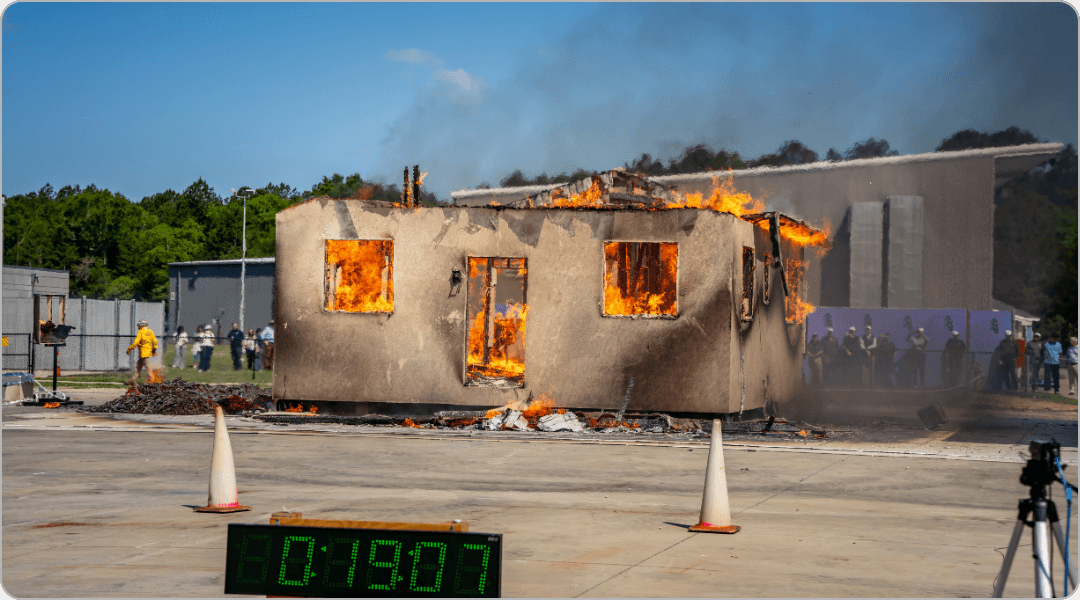
Source: IBHS
Plus: A look inside wildfire research at IBHS
Welcome back to This Week in Disasters! This newsletter combines expert perspectives with a weekly roundup of upcoming threats, recent natural disasters, and available survivor assistance. If you’re a Risk, Insurance, Employee Assistance, NGO or Emergency Management professional (or you’re just really curious about disasters in the United States!) you’re in the right place.
Major Disasters of the Last Week
The Max Road Fire in Broward County reached more than 11,400 acres before crews reported it "contained and controlled" on Wednesday, four days after it ignited near Mack's Fish Camp on May 10. Read more. |
A supercell complex produced hail up to 4.5 inches in diameter, 84 mph wind gusts, and 18,000 power outages across parts of Texas. Read more. |
Governor Dunleavy of Alaska issued a State Disaster Declaration on May 11 after spring breakup ice jams flooded two Interior villages, displacing 61 of 78 residents in Hughes into the tribal hall shelter starting May 9 and damaging about eight homes in Chalkyitsik on May 7. Read more. |
A lightning-sparked grass fire (Hunggate Fore) in Randall County, TX grew to more than 14,000 acres by Thursday evening with 10 percent containment, prompting mandatory evacuations. Read more. |
Forecasted Risks for Next Week
Severe storms and tornadoes are expected across the Plains and Mississippi Valley from Friday through Tuesday, with the most significant tornado threat developing Saturday from Oklahoma into Iowa.
Critical fire weather conditions will continue across north and central Florida, with relative humidity in the 25 to 35 percent range and southwest gusts to 25 mph keeping the state's drought-driven wildfire activity elevated even as the Max Road Fire winds down.
Monday will bring a broad severe weather corridor from Texas through Wisconsin and Minnesota, outlining risk for very large hail, damaging winds, and multiple tornadoes.
The National Hurricane Center begins issuing routine Tropical Weather Outlooks on Friday, May 15, two weeks ahead of the official June 1 start of Atlantic hurricane season. NOAA's full seasonal outlook follows on May 21.
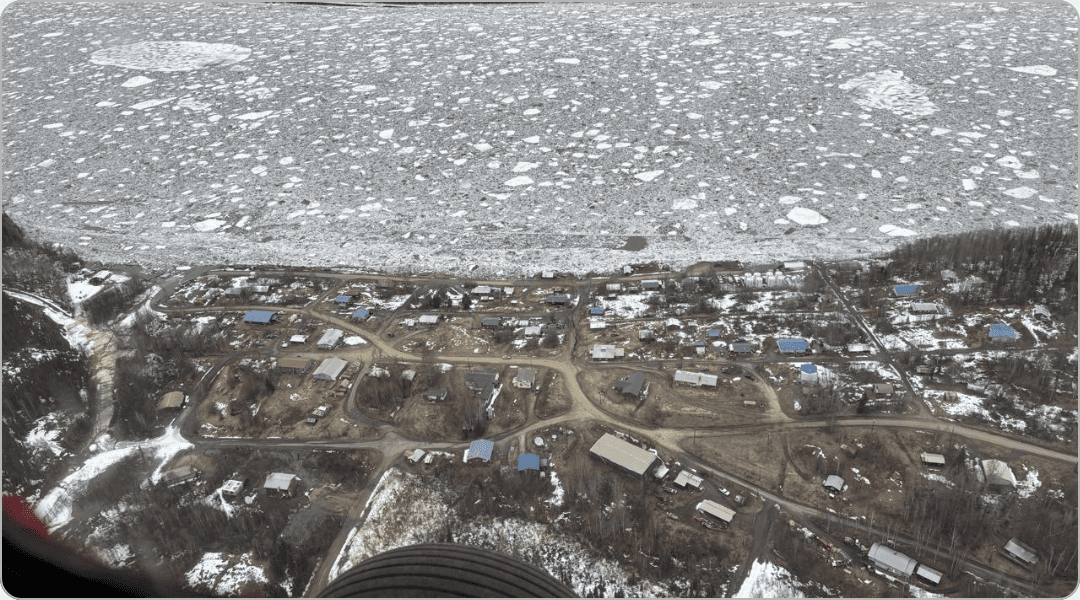
Ice jam in Alaska. Source: Alaska Division of Homeland Security
Disasters in the Headlines
The Only City in America Hoping for a Hurricane
How to Build Disaster Resilience
The Weekly: Why This Wildfire Season is Already Breaking Records
PRO PERSPECTIVE
Inside the Research Reshaping WUI Resilience
Source: IBHS
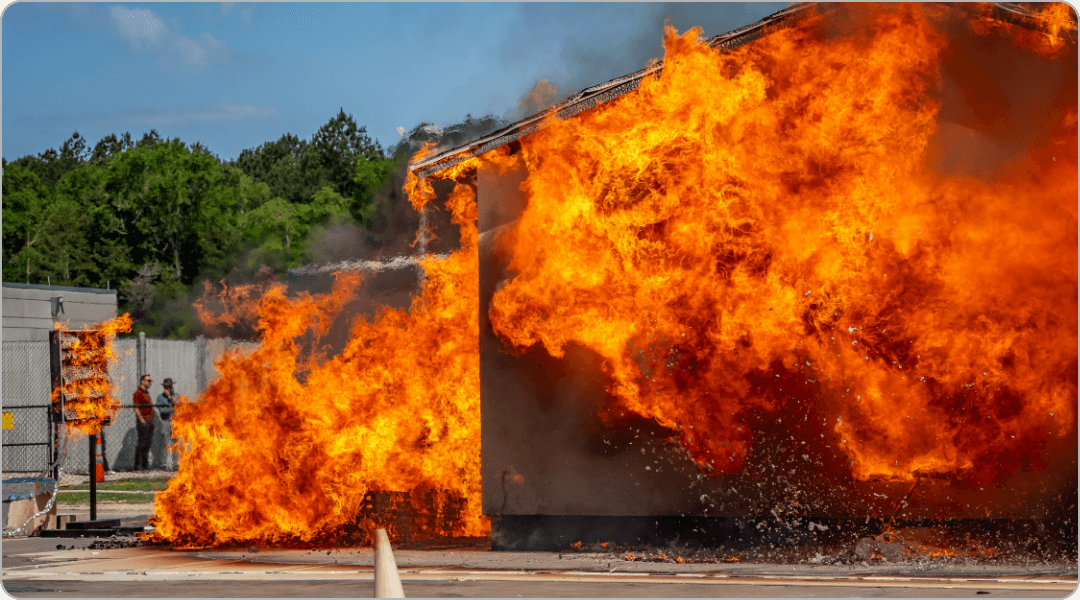
At the IBHS Research Center in Richburg, South Carolina, a 600-square-foot home sat fully furnished. Clothes in the closets. Chips and olive oil in the pantry. Within the hour, it would be set on fire, and a home 20 feet downwind would be the actual subject of the experiment.
It was the 14th time IBHS had run this scenario.
"What we're doing here today is really looking at building-to-building fire spread," said Dr. Murray Morrison, IBHS Managing Director of Research, walking the group through the setup. "We're simulating the fire getting into the community, and this is the first structure to be ignited."
Morrison leads the institute's full research program. He came to IBHS in 2011 with a PhD in wind engineering and a background running full-scale wind tunnel experiments at the University of Western Ontario. The most strategically ambitious work running out of his shop today is the multi-year Wind-Driven Building-to-Building Fire Spread series, run in partnership with CAL FIRE and UC Berkeley to put a defensible number on a question the wildfire community has never had clean data on.
When wildfire enters a neighborhood and ignites one home, what determines whether the next one survives?
The previous test answered with a no
The last 20-foot burn in the series did not end the way IBHS wanted it to.
"This is the second test we've done at 20 feet, and it did ignite that target structure," Morrison said. The source ADU in that prior burn had combustible wood siding, fully compliant with California's WUI code. Compliant, and still enough to take down the neighbor.
This experiment changed a few variables. 20-foot separation, flucuating (gusting between 30 and 50 miles per hour), and stucco structure all at the same time. The hypothesis under examination was whether replacing a single component on the burning home would be enough to break the chain of ignition from reaching the next one. That is the kind of question that has historically been answered with post-fire forensics, where every variable changes at once. This experiment strips it back to one.
"If the fire burns less intensely for longer, or it burns very intensely for a shorter time, that is going to make a difference to that downwind structure and its susceptibility," Morrison explained.
Peak heat release rate is the variable engineers care about, because the moment of maximum thermal exposure is when the downwind home is most likely to fail. And peak heat release rate is set by what's actually inside the burning structure. The clothes in the closets and the groceries in the pantry are not staging. They are fuel. Without them, the source ADU burns too cool and too fast, and the heat curve the target structure sees stops looking anything like a real house fire.
The target structure was the opposite of the source. Hardened, instrumented, and outfitted with roughly half a million dollars in sensors measuring radiation, heat flux, and surface temperatures. Removable wall panels and window assemblies along its exposed face could be tested as additional specimens within the same burn, multiplying what the institute learns from each event.
"We can take all this data and look at different building materials and their susceptibility," Morrison said. "It gives us what we should be designing for, what we should be trying to resist."
Why the test pad matters: the view from the program lead
What happens inside the ADU is engineering. What it means in the field belongs to Steve Hawks, IBHS Senior Director for Wildfire, who turns the institute's research into state-level programs, codes, and partnerships.
Hawks brought a particular kind of stake to that work. He grew up in Paradise, California. On the morning of November 8, 2018, he watched the smoke column from his office in Sacramento, drove north, and tried to locate his parents as the Camp Fire moved across the town he had been raised in. Their house was one of 18,804 structures destroyed. When he reached town, the lights were out in the middle of the day.
"All the time that I responded to fires over the years, it was just... you go, you do your job, you go home. You go to the next one," Hawks said. "This one was personal."
The single number that anchors his strategy comes out of the post-fire damage database IBHS has been building for more than a decade, now sitting at roughly 140,000 inspected homes. Once a fire ignites a structure, the home is a total loss in 94 percent of cases. Cosmetic damage accounts for about 4 percent. Minor and major damage combined make up the rest. Almost nothing in between.
"At that point, firefighters have written that house off. They've moved on to the next one they can maybe save," Hawks said. "It's all about preventing the ignition. Once it occurs, we really can't stop it from being total loss."
That is why Morrison's 20-foot burn mattered. The 94 percent number describes what happens after a home ignites. The experiment describes what determines whether it does.
It is also why the IBHS programs aimed at homeowners, neighborhoods, and multifamily housing all converge on the same principle. The Wildfire Prepared Home standard, the Wildfire Prepared Neighborhood designation (Dixon Trail in San Diego County is the first), and the multifamily program now expanding into 10 additional states are different applications of the same engineering question Morrison was putting to the chamber: how do you change a building's response when fire arrives at its surface?
Hawks is careful about how that work gets delivered into any new jurisdiction.
"We're not there to push you aside and take over. You've been in your state, in your local jurisdiction, forever," he said. "We want to be good partners. We want to amplify what you're already doing."
What to take from this
For emergency managers, insurance leaders, and recovery stakeholders, three things are worth carrying out of this ADU burn experiment.
The post-fire math is already written. Once a home ignites in a wildfire event, the outcome is largely fixed. Recovery strategy, insurance pricing, and code advocacy all sit downstream of one variable, which is whether structures ignite in the first place.
Separation distances and exterior materials are not abstract code requirements. They are the variables IBHS is testing one at a time, with full-scale fires and real fuel loads, to determine what actually breaks the chain of ignition between structures. This burn was one cladding change at 20 feet. The next phase of the program will move into existing housing stock that does not meet California's Chapter 7A code, which is most of the West.
Insurability follows ignitability. If a community has a path to reducing structure loss at scale, the conversation with carriers and the Fair Plan begins to change character. The experiment data is what makes that conversation an evidence-based one.
"Our goal," Morrison said as the chamber was being prepared, "is to try not to ignite the target structure."
Whether that goal was met or not, the data coming out of the IBHS test pad is the data the next neighborhood will be built on. And as Hawks would put it, the fire is not what makes the home a total loss. The choices made before the fire are.
Active Federal Major Disasters
There is usually a 60 day window to apply for help after a disaster is declared. The following disasters are still actively taking applications from survivors for financial support.
The following disasters are actively taking applications from survivors for financial support. To apply, survivors can visit DisasterAssistance.gov or call the FEMA Helpline at 1-800‑621‑3362.
Mississippi - Severe Winter StormSTATUS Major Disaster declared February 6, 2026; IA applications accepted in eligible counties until June 10, 2026. AFFECTED COUNTIES Adams, Alcorn, Attala, Benton, Bolivar, Calhoun, Carroll, Claiborne, Coahoma, DeSoto, Grenada, Holmes, Humphreys, Issaquena, Jefferson, Lafayette, Lee, Leflore, Marshall, Mississippi Choctaw Indian Reservation, Montgomery, Panola, Pontotoc, Prentiss, Quitman, Sharkey, Sunflower, Tallahatchie, Tate, Tippah, Tishomingo, Tunica, Union, Warren, Washington, Yalobusha, Yazoo |
Tennessee - Severe Winter StormSTATUS Major Disaster declared February 6, 2026; IA applications accepted in eligible counties until June 10, 2026. AFFECTED COUNTIES Benton, Carroll, Cheatham, Chester, Clay, Davidson, Decatur, Dickson, Dyer, Fayette, Hardeman, Hardin, Henderson, Hickman, Lewis, Macon, Madison, Maury, McNairy, Montgomery, Perry, Robertson, Rutherford, Shelby, Sumner, Trousdale, Wayne, Williamson, Wilson |
Washington - Severe Storms, Straight-line Winds, Flooding, Landslides, and MudslidesSTATUS Major Disaster declared April 7, 2026; IA applications accepted in eligible counties until June 10, 2026. AFFECTED COUNTIES Chehalis Indian Reservation, Chelan, Grays Harbor, King, Lewis, Lummi Indian Reservation, Muckleshoot Indian Reservation, Nisqually Indian Reservation, Nooksack Indian Reservation, Pacific, Pierce, Puyallup Indian Reservation, Quinault Indian Reservation, Samish (TDSA), Sauk-Suiattle Indian Reservation, Shoalwater Bay Reservation, Skagit, Snohomish, Squaxin Island Indian Reservation, Stillaguamish Indian Reservation, Swinomish Indian Reservation, Thurston, Tulalip Indian Reservation, Upper Skagit Indian Reservation, Whatcom |
Hawaii - Kona Low Weather SystemsSTATUS Major Disaster declared April 7, 2026; IA applications accepted in eligible counties until June 14, 2026. AFFECTED COUNTIES Hawaii, Honolulu, Maui |
[NEW] Commonwealth of the Northern Mariana Islands - Super Typhoon SinlakuSTATUS Major Disaster declared April 23, 2026; IA applications accepted in eligible counties until June 22, 2026. AFFECTED COUNTIES Northern Islands, Rota, Saipan, Tinian |
North Carolina - Flooding and Storm Damage from Tropical Storm ChantalSTATUS SBA disaster declaration approved July 26, 2025; applications open for residents and businesses in eight NC counties. The deadline to return economic injury applications has been extended to September 30, 2026. APPLY NOW AFFECTED COUNTIES Alamance, Caswell, Chatham, Durham, Granville, Orange, Person, Wake Counties |
Sign up for This Week in Disasters here.