Are you a disaster survivor looking for help? Click here
This Week in Disasters
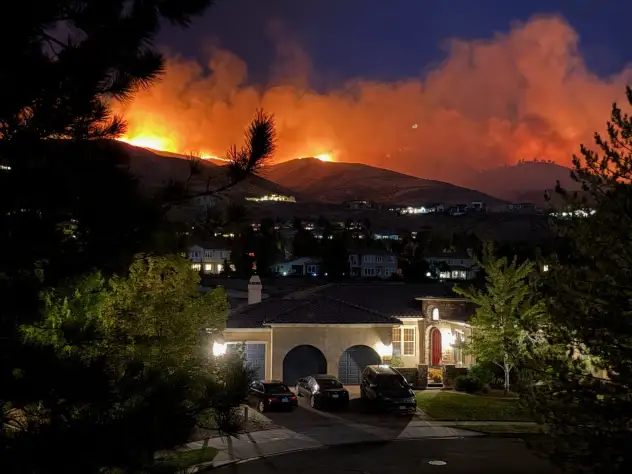
Hawk Fire. Source: Truckee Meadows Fire Protection Distraction
Plus, a wildfire at Reno's edge put 42,000 people under mandatory evacuation orders and destroyed 47 homes.
Welcome back to This Week in Disasters! This newsletter combines expert perspectives with a weekly roundup of upcoming threats, recent natural disasters, and available survivor assistance. If you’re a Risk, Insurance, Employee Assistance, NGO or Emergency Management professional (or you’re just really curious about disasters in the United States!) you’re in the right place.
Major Disasters of the Last Week
A wind-driven brush fire that ignited August 22 northwest of Reno burned 15,085 acres and destroyed 47 homes before crews reached 95% containment. At its peak the fire forced evacuations of 42,000 people from their homes, prompted a Washoe County state of emergency under Gov. Joe Lombardo, closed a stretch of U.S. 395, and cut power to as many as 60,000 customers. Read more. |
The Ross Fire has burned over 85,000 acres across Palo Pinto and Jack counties, making it the second-largest wildfire in North Texas history. Five structures have been destroyed, 630 households were evacuated as of Tuesday, and crews are working the fire's western edge as winds shift. Read more. |
Forecasted Risks for Next Week
Severe storms are expected across the central and northern Plains this weekend. Damaging wind gusts, very large hail, and tornadoes are possible as a trough moves out of the Pacific Northwest into South Dakota and neighboring states Saturday into Sunday.
The remnants of Tropical Storm Dolly could bring heavy rain to Puerto Rico and the U.S. Virgin Islands Sunday into Monday. Flash flooding is possible in higher terrain after the system passes the Leeward Islands late Saturday. NHC expects Dolly to go post-tropical Saturday afternoon and weaken to a remnant low by Sunday morning.
Critical fire weather continues across Texas. 77% of the state is in drought and Dallas, San Antonio, and Waco are recording their driest start to August on record. These conditions will challenge Ross Fire containment lines and favor new the starts of new fires.
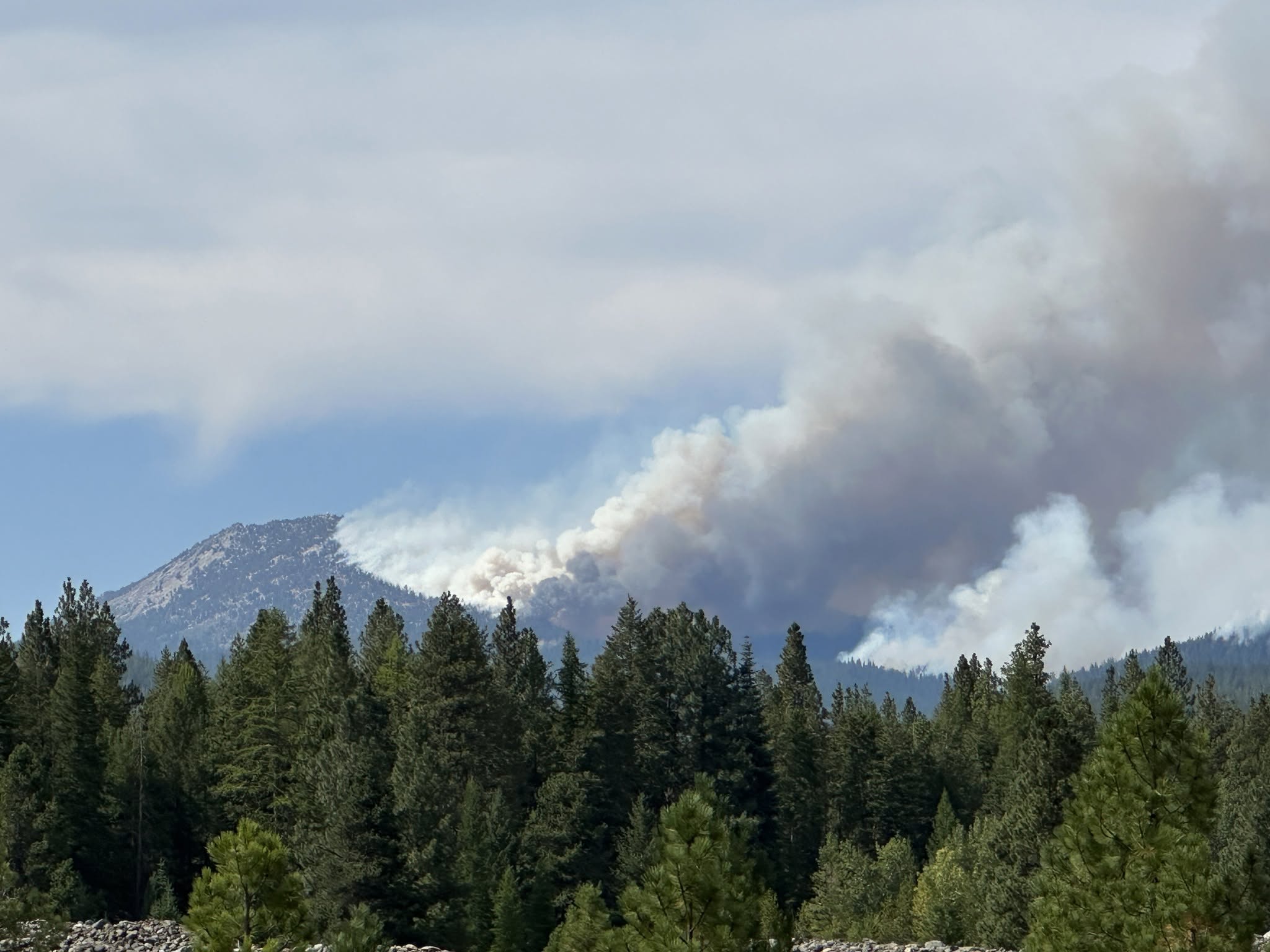
McCulley Fires. Source: U.S. Forest Service - Wollowa Whitman National Forest
Disasters in the Headlines
Putting Indiana’s Historic Flooding in Context
Report: How State and Local Governments Can Fill the Gaps in Rural Disaster Relief
PRO PERSPECTIVE
Never Again Has a Shelf Life

Abby Ross, CEO of The Resiliency Company, opens her argument with a roof. Builders already know how to keep one attached to a house through most hurricanes: the FORTIFIED standard specifies the materials and methods, and a contractor network installs them. "We don't have to invent anything wildly new," Ross says. "We just need to build things differently." The barrier is not missing technology. It is a system wired to rebuild to code and stop there, and Ross built a national nonprofit to rewire it.
Six weeks of money, six years of recovery
Ross found the problem in a dataset. After a decade building education software, she became CEO of Network for Good, the donor-advised fund launched right after September 11, 2001, that has sent more than $5 billion to over 450,000 charities. The fund's flows showed disasters arriving closer together, hitting harder, and landing in places that had not planned for them. Most of the money arrived in the first six weeks. Recoveries took six years. Two hundred discovery calls across FEMA, insurance, and impact investing later, she found no one organizing the people who decide what gets built. The Resiliency Company became her answer. She sums up the job as shaping markets and minds, and minds have to move first for money to follow.
The Los Angeles test
Minds move fastest right after disaster, when risk stops being abstract and communities swear never again. The Eaton and Palisades fires handed Ross that moment, and Los Angeles became the first full test. The Resiliency Company launched Resilient Los Angeles to support the rebuild, plus the Resilient Delta Fund: grants and loans that close the cost gap between a code-compliant home and a resilient one. "This is not a pilot. It's a precedent," Ross says. The goal is a rebuild the next community can pick up and run, where resilient construction is simply how homes get built. The friction is velocity. Survivors want to get home fast; anything that adds cost or decisions reads as delay. Ross refuses the trade-off: "Resilience should not be the cherry on top." A priority that waits until the end of the rebuilding process never makes it in.
Upstream first, then the money
Baking it in starts with builders. One of Ross's colleagues in Los Angeles saw it early: funding, financing, and insurance discounts all fail if the house was never engineered to the standard. "If it doesn't happen upstream, it certainly can't happen downstream," Ross says. So Resilient Los Angeles began by educating builders and architects on what a resilient home is and what it earns. The pitch landed because insurability shapes the builders' own market: a home an insurer will cover is easier to sell, and some Builders Alliance members now treat the insurable standard as a competitive advantage.
Downstream sits the money, and Ross is blunt about why lenders have been slow to treat above-code construction as an asset improvement. "The risk is increasing at a rate institutions have not seen before and are not totally prepared to solve for," she says. Banks are also regulated by design; their caution is intentional. Her bet: local lenders and community development financial institutions lead recovery lending, commercial lenders scale what they prove, until a homeowner can finance a resilient roof the way they finance a kitchen remodel.
The homeowner math already works. Insurance payouts and traditional financing pay to rebuild to code, so the resilient increment "feels like extra," Ross says, when it is essential to survivability and insurability. Her counter frames that increment as an investment: a lower insurance bill, better odds of staying insured, and a more valuable home. Alabama has already proven the value piece. A peer-reviewed University of Alabama study found a FORTIFIED designation raises resale value by nearly 7 percent, and Ross expects wildfire hardening in California's wildland-urban interface to follow the same curve.
The house for the next 30 years
A hardened parcel alone does not stop a fire that spreads house to house. That takes a neighborhood. Ross's hypothesis runs bottom-up: put financing within reach of individual homeowners first, and the momentum makes neighborhood-scale coordination possible, including the IBHS Wildfire Prepared Neighborhood standard. Her team published a grants playbook after the fires so a community-level program can run the moment public dollars appear. The last barrier is desire. People have to want these homes, and nobody pictures themselves in a concrete box. "This isn't Mad Max," Ross says. "This is just adapting our world." Ross points to Case Study: Adapt as proof that resilient can be beautiful. Co-founded by Dustin Bramell after he lost his own Palisades home, the initiative has paired 16 fire-impacted families with top Los Angeles architecture firms while Architectural Digest documents the builds.
The argument circles back to the roof. The standards, the contractors, the resale data, the lending instruments, and the architecture all exist. What does not yet exist is the default, at every link in the chain, to build past code. "It's tough to say build a house for the next 30 years," Ross says, "but that's exactly what we're asking homeowners and communities to do." Nothing in that ask waits on an invention. It waits on a decision, made upstream by builders, financed by lenders, rewarded by insurers, and repeated in community after community until nobody calls resilience extra.
The Resiliency Company publishes a great weekly newsletter called The Epicenter. You should check it out and subscribe!
Active Federal Declared Disasters and Deadlines
There is usually a 60 day window to apply for help after a disaster is declared. The following disasters are actively taking applications from survivors for financial support. To apply, survivors can visit DisasterAssistance.gov or call the FEMA Helpline at 1-800‑621‑3362.
Mississippi - Severe Storms, Straight-line Winds, Tornadoes, and FloodingSTATUS Major Disaster declared June 30, 2026; IA applications accepted in eligible counties until August 31, 2026 AFFECTED COUNTIES Franklin, Lawrence, Lincoln, Wilkinson |
Wisconsin - Severe Storms, Tornadoes, and FloodingSTATUS Major Disaster declared June 30, 2026; IA applications accepted in eligible counties until August 31, 2026 AFFECTED COUNTIES Bayfield, Brown, Buffalo, Jackson, Jefferson, Juneau, Kenosha, Manitowoc, Marathon, Milwaukee, Outagamie, Oneida Nation, Racine, Rock, Sauk, Vernon, Washington, Waukesha, Waupaca, Winnebago |
Michigan - Severe Storms, Tornadoes, and FloodingSTATUS Major Disaster declared June 30, 2026; IA applications accepted in eligible counties until August 31, 2026 AFFECTED COUNTIES Alcona, Allegan, Alpena, Antrim, Barry, Benzie, Charlevoix, Cheboygan, Crawford, Emmet, Grand Traverse, Gratiot, Iosco, Kalamazoo, Kalkaska, Manistee, Mecosta, Montcalm, Muskegon, Newaygo, Oceana, Osceola, Presque Isle, Roscommon, Saginaw, Washtenaw, Wexford |
Fort Peck Tribe - Severe Winter Storm and Straightline WindsSTATUS Major Disaster declared May 29, 2026; IA applications accepted in eligible counties until August 31, 2026 AFFECTED COUNTIES Fort Peck Indian Reservation |
Crow Tribe of Montana - Severe Winter Storm and Straightline WindsSTATUS Major Disaster declared May 29, 2026; IA applications accepted in eligible counties until August 31, 2026 AFFECTED COUNTIES Crow Indian Reservation |
Louisiana - Tropical Storm ArthurSTATUS Major Disaster declared June 30, 2026; IA applications accepted in eligible counties until October 1, 2026 AFFECTED COUNTIES Avoyelles, St. Landry, St. Tammany, Terrebonne |
West Virginia - Severe Storm, Straight-line Winds, Tornadoes, Flooding, Landslides, and MudslidesSTATUS Major Disaster declared August 3, 2026; IA applications accepted in eligible counties until October 3, 2026 AFFECTED COUNTIES Lewis, Upshur |
Northern Mariana Islands - Super Typhoon BaviSTATUS Major Disaster declared August 3, 2026; IA applications accepted in eligible counties until October 3, 2026 AFFECTED COUNTIES Rota (Municipality) |
Mississippi - Tropical Storm ArthurSTATUS Major Disaster declared August 3, 2026; IA applications accepted in eligible counties until October 3, 2026 AFFECTED COUNTIES Hancock, Harrison, Pearl River, Stone |
NEW Indiana - Severe Storm, Straight-line Winds, Tornadoes, and FloodingSTATUS Major Disaster declared August 25, 2026; IA applications accepted in eligible counties until October 25, 2026 AFFECTED COUNTIES Hancock, Harrison, Pearl River, Stone |
Sign up for This Week in Disasters here.