Are you a disaster survivor looking for help? Click here
This Week in Disasters
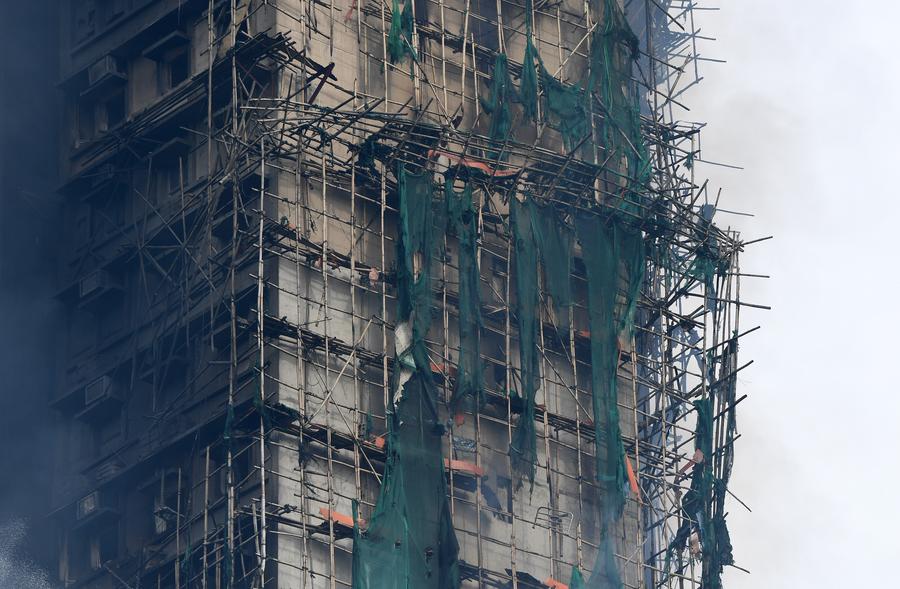
Remnants of the Hong Kong fire on November 26, 2025. (Source: China Focus)
Plus, emergency’s management constant state of disaster endurance
Welcome back to This Week in Disasters! This newsletter combines expert perspectives with a weekly roundup of upcoming threats, recent natural disasters, and available survivor assistance. If you’re an HR, Risk, Employee Assistance, or Emergency Management professional (or you’re just really curious about disasters in the United States!) you’re in the right place.
Major Disasters of the Last Week
A push of Arctic air across the Northern Plains, Upper Midwest, Great Lake NortheastThis brought freezing temperatures and the first significant snowfall of the season with several inches in spots. This led to slick roads, minor crashes, dangerous wind chills, and some school disruptions. Read more... |
Snow squalls swept from the Great Lakes region to the NortheastThis raised risk of vehicle accidents and travel delays. Read more... |
Forecasted Risks for Next Week
More Arctic air moves into the Northern Plains and upper Midwest this weekend keeping some areas in the single digits by Sunday before the cold dives south on Monday and drops temperatures 10–15°F along the Appalachians and the I-95 corridor from Philadelphia to Boston, where highs may struggle to reach freezing and winds will make it feel even colder.
Three atmospheric rivers forecast to make landfall over the Pacific Northwest through December 10.
Disasters in the Headlines
Dysfunctional Checks and Balances Are to Blame for Hong Kong’s Devastating Fire – Not Bamboo Scaffolding
Zillow Removes Climate Risk Scores From Home Listings
How Mobile, Alabama is turning disaster insights into actions
U.S. Chamber of Commerce
Can Landscaping Protect Homes in the Face of Extreme Wildfire?
The Heat Is On
Governors Welcome Action on “Fixing Emergency Management for Americans” (FEMA) Act
PRO PERSPECTIVE
The New Reality of Emergency Management: When Disasters Never Stop
For Andrew Phelps, Chief Operating Officer at AC Disaster Consulting and former director of the Oregon Department of Emergency Management, one of the defining challenges in today’s emergency management landscape is the sheer complexity of modern disasters. It is not a particular hazard, it is the pace. “We are no longer in response mode or recovery mode,” he said. “Everything is happening at once.” That sense of nonstop activity, he explained, has transformed emergency management from a cycle into a constant state of disaster endurance.

A single incident often spirals into multiple layers of impact. For example, a single wildfire can trigger:
Evacuations that strain transportation and shelter systems
Smoke conditions that overwhelm public health agencies
Unsolicited donations that block fire stations
Drones that interrupt aviation operations
These cascading issues are the new baseline for communities across the country. They often stretch local systems long before recovery even begins.
Phelps explained that unpredictability is amplifying the strain. Communities are experiencing hazards they have never faced before: new flood-prone zones, wildfires outside traditional seasons, and hurricane seasons that look nothing like preseason forecasts. “It is getting harder to know where bad things will happen, when they will happen, and how bad they might be.”
This increasingly unstable environment is colliding with systems that were never designed for constant activation. Many communities now facing repeated disasters lack the staffing, funding, and infrastructure required for sustained response. Phelps noted that this strain extends to households as well. Families are urged to prepare, yet many do not have the financial margin to stockpile food, water, or emergency savings. Effective preparedness, he emphasized, requires messaging and policies that reflect these realities rather than assuming every family can “get ready” in the same way
His most pointed insight is that hazards may be natural, but disasters are created long before the event occurs. “Nearly every disaster I have worked on has been the direct result of policy decisions,” he said. Phelps emphasized that risk is shaped by choices about land use, housing, infrastructure, zoning, and the investments communities make (or fail to make) over decades:
Building in floodplains
Allowing homes to sit deep in wildfire-prone forests
Maintaining outdated seismic codes
Collectively, these choices are what transform a natural hazard into a disaster. In his view, resilience begins not with the moment of impact but with the decisions that determine who and what is in harm’s way.
Phelps emphasized that meeting this moment requires a broader, more forward-looking approach to resilience. Emergency managers, he said, are being asked to solve increasingly complex problems with systems that were originally designed for simpler, more isolated events. Strengthening resilience means investing in the relationships, policies, and community-level systems that can reduce cascading impacts before they start.
Active Federal Major Disasters
There is usually a 60 day window to apply for help after a disaster is declared. The following disasters are still actively taking applications from survivors for financial support.
The following disasters are actively taking applications from survivors for financial support. To apply, survivors can visit DisasterAssistance.gov or call the FEMA Helpline at 1-800‑621‑3362.
Sisseton-Wahpeton Oyate - Severe Storms & FloodingSTATUS Major Disaster declared September 11, 2025; IA applications accepted in eligible counties until December 5, 2025. AFFECTED COUNTIES Lake Traverse (Sisseton) Indian Reservation |
Alaska - Severe Storms, Flooding, and Remnants of Typhoon HalongSTATUS Major Disaster declared October 22, 2025; IA applications accepted in eligible counties until December 22, 2025. AFFECTED COUNTIES Lower Kuskokwim Regional Educational Attendance Area, Lower Yukon Regional Educational Attendance Area, Northwest Arctic |
Missouri - Severe Storms, Flooding, Straight Line Winds, Tornadoes & FloodingSTATUS Major Disaster declared May 21, 2025; 20 more counties added for IA on October 23, 2025; IA applications in eligible counties until December 22. AFFECTED COUNTIES Bollinger, Butler, Cape Girardeau, Carter, Cooper, Dunklin, Howell, Iron, Mississippi, New Madrid, Oregon, Ozark, Reynolds, Ripley, Scott, Shannon, Stoddard, Vernon, Washington, Wayne |
Leech Lake Band of Ojibwe - Severe Storms, Flooding & Straight Line WindsSTATUS Major Disaster declared October 22, 2025; IA applications accepted in eligible counties until December 30, 2025. AFFECTED COUNTIES Leech Lake Indian Reservation |
Sign up for This Week in Disasters here.
Need more support for your employees or constituents? Bright Harbor can help.