Are you a disaster survivor looking for help? Click here
This Week in Disasters
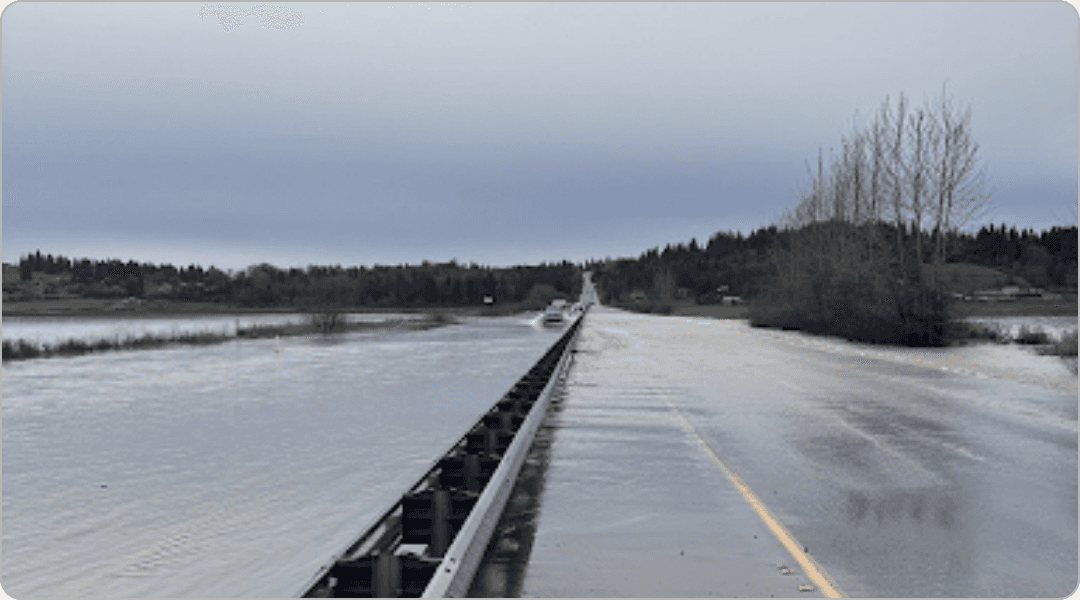
Photo: Washington State Department of Transportation (WSDOT) Official Twitter/X Accoun
Plus, with no report, no meetings, and no clear direction, FEMA reform remains stalled amid competing political paths and rising disaster rick.
Welcome back to This Week in Disasters! This newsletter combines expert perspectives with a weekly roundup of upcoming threats, recent natural disasters, and available survivor assistance. If you’re an HR, Risk, Employee Assistance, or Emergency Management professional (or you’re just really curious about disasters in the United States!) you’re in the right place.
While the FEMA Review Council meeting was not held, the Carnegie Endowment webinar The Future of FEMA: Lessons From 2025 and What Comes Next is still taking place as scheduled. The webinar will bring together experts (including our very own Pete Gaynor) to discuss recent disaster response experiences, what they reveal about FEMA’s role, and possible directions for federal emergency management in the year ahead.
When: Monday, December 15, 1:00pm - 2:15pm EST
Where: Online
Sign up for the webinar here.
Major Disasters of the Last Week
A powerful atmospheric river drenched the Pacific NorthwestThis is triggering severe flooding across Washington and parts of Oregon. Rivers and lowlands have been inundated with sustained rainfall, leading to declarations of emergency, deployment of the National Guard, and evacuation alerts for an estimated 100,000+ people in Washington as rising water threatens communities and infrastructure. This is an ongoing event. Read more... |
A magnitude 7.0 earthquake struck a remote region near the Alaska-Canada borderThe earthquake was felt in small communities including Yakutat and Whitehorse. There were no immediate reports of serious injuries or structural damage, but the quake was significant given its size. Read more... |
Forecasted Risks for Next Week
Temperatures are expected to fall 30-45 degrees below average across the Midwest and Ohio Valley on Sunday
This week’s atmospheric river will potentially combine with a new atmospheric river early next week and hit the Pacific Northwest again.
In the next few days, two fast-moving clipper systems are expected to sweep from the Midwest into the Northeast, bringing light but accumulating snow to cities like NYC, Philadelphia, and Boston along with a surge of colder Arctic air..
Disasters in the Headlines
Judge orders FEMA to reverse cancelation of infrastructure resilience program
IBHS 2025 Los Angeles County Wildfires Report
Highly anticipated meeting on the future of FEMA abruptly canceled
The Hill
Denied Federal Disaster Aid, a Town in Trump Country Feels Forgotten
The New York Times
PRO PERSPECTIVE
Facts Evolving, Messaging Adjusting (FEMA)
It has been a week. No council meeting. No FEMA reform report. No certainty. No predictability. No clarity.

Possible paths.
First, DHS releases the report, which receives public scrutiny, some favorable and some unfavorable. The White House approves the report and directs its implementation. Then the real work begins. FEMA staff and lawyers must translate vague and often contradictory council language into coherent, implementable policy. Bottlenecks include OMB review, interagency clearance, legal authorities, budget implications, and timelines. On a 1 to 10 probability scale, with 10 being the highest, this scenario is a 5.
Second, the White House rejects the report. It lacks the necessary reform “ingredients” and is shelved. Twelve months of hard work by the council, including several worthwhile ideas, go straight into the burn bag. Proof. On a 1 to 10 probability scale, this is also a 5.
Third, the White House directs the council to start over, which is highly unlikely. On the 1 to 10 probability scale, this is a negative 5.
Fourth, the White House advances its own internal reform ideas, which again receive public scrutiny, some favorable and some unfavorable. On a 1 to 10 probability scale, this is a 6.
Fifth, the White House chooses to use the existing Transportation and Infrastructure draft FEMA Act of 2025 as a pathway to a declared reform victory. This is the longest and most politically complex route, with the greatest risk and the lowest likelihood of producing true reform once lawmakers dismantle it through negotiation and compromise. This is where we must distinguish between a path that delivers a “declared victory” and one that achieves “true reform.” On a 1 to 10 probability scale, declared victory scores a 10, while true reform scores a 2.
Sixth, the White House loses interest in FEMA reform altogether, shifts to other priorities, and instructs the DHS Secretary to handle it. On a 1 to 10 probability scale, this is a 4.
So what will it take to achieve meaningful, lasting reform? First, it requires leadership and expert policy staff who fully understand the multi dimensional, multi stakeholder nature of this wicked problem. Many in the reform community have offered thoughtful diagnoses, but far fewer have advanced workable solutions. Real solutions will require legislative buy in, targeted regulatory changes, and most critically broad support from major stakeholders and end users, including elected officials across the country who will ultimately be responsible for implementing and living with any significant reform.
And by the way, there are 171 days until the Atlantic hurricane season, but earthquakes, floods, and tornadoes do not wait for a calendar.
Days after the FEMA Reform Council concluded its work, there is still no report, no meetings, and no clear direction. Only uncertainty. Several paths remain, ranging from releasing the report for implementation, to shelving it, pursuing internal White House ideas, relying on existing legislation for a symbolic reform win, or simply moving on. Each carries distinct political and operational risks, with the highest probability favoring visible action over meaningful structural change. The central question is not whether reform will be declared, but whether it will be real. In the end, the most important outcome is improved safety and security for the nation and for the disaster survivors we serve.
Active Federal Major Disasters
There is usually a 60 day window to apply for help after a disaster is declared. The following disasters are still actively taking applications from survivors for financial support.
The following disasters are actively taking applications from survivors for financial support. To apply, survivors can visit DisasterAssistance.gov or call the FEMA Helpline at 1-800‑621‑3362.
Alaska - Severe Storms, Flooding, and Remnants of Typhoon HalongSTATUS Major Disaster declared October 22, 2025; IA applications accepted in eligible counties until December 22, 2025. AFFECTED COUNTIES Lower Kuskokwim Regional Educational Attendance Area, Lower Yukon Regional Educational Attendance Area, Northwest Arctic |
Missouri - Severe Storms, Flooding, Straight Line Winds, Tornadoes & FloodingSTATUS Major Disaster declared May 21, 2025; 20 more counties added for IA on October 23, 2025; IA applications in eligible counties until December 22. AFFECTED COUNTIES Bollinger, Butler, Cape Girardeau, Carter, Cooper, Dunklin, Howell, Iron, Mississippi, New Madrid, Oregon, Ozark, Reynolds, Ripley, Scott, Shannon, Stoddard, Vernon, Washington, Wayne |
Leech Lake Band of Ojibwe - Severe Storms, Flooding & Straight Line WindsSTATUS Major Disaster declared October 22, 2025; IA applications accepted in eligible counties until December 30, 2025. AFFECTED COUNTIES Leech Lake Indian Reservation |
Sign up for This Week in Disasters here.
Need more support for your employees or constituents? Bright Harbor can help.